
← All marine life
Hubb's Octopus
Species IUCN · Least Concern (LC)

Hubb's Octopus

Octopus hubbsorum, S. S. Berry, 1953

marine

About Hubb's Octopus

Octopus hubbsorum (also known as Hubb's octopus), is an octopus in the family Octopodidae. It is commonly found along tropical waters along the central Pacific Coast of Mexico. Here, they are one of the most commonly caught cephalopods and are commercially extremely important for the economy.

Diet

O. hubbsorum, like all other octopods, display carnivorous tendencies. Their diet, however, varies throughout their lifespan. The typical diet of mature individuals is rather broad when compared to the diet of juveniles. One study found that O. hubbsorum feeds on 50 different types of prey. There is a notable difference between the diets of mature males and females. This is seen in other species of octopuses and is most likely due to the fact that female octopuses are more metabolically taxed when reproducing. These reproducing females are noticed to ingest organisms that are not frequently ingested by others, most likely due to the need to stay close to the nest and just eating what is available. Senscent females (post reproduction) when monitored, were more likely to have empty stomachs when caught when compared to males of the same age.
Behaviour

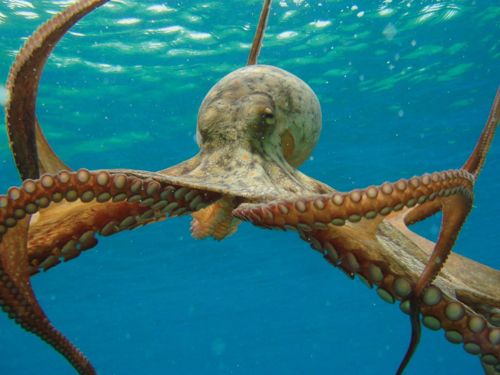
O. hubbsorum is a benthic free-swimming octopus commonly found in intertidal and shallow subtidal zones of the Mexico pacific. Typically, they are found hiding in small places along coral reefs in shallow waters. Additionally, they do not stay in one area, rather they display seasonal movement due to changes in diet patterns. The typical mantle length is medium sized at 220 mm (8.7 in) with an average weight of 766.6 g (27.04 oz). It has been found that there is a continuous mature population, which can be accredited to the warmer waters they live in. Additionally, mature males were typically smaller than mature females. The species was noticed to have no ocelli. Some other physical characteristics include a rounded mantle shape, individually enlarged proximal suckers in males and females, and tapered arms.

Reproduction

O. hubbsorum spawns with synchronous ovulation, where egg laying is followed by the animal's death (simultaneous terminal spawning). During this period, there is a lack of oocyte maturation. The eggs are cared for by the mother and are laid in a cave or a den. The growth and feeding habits of the female slows during the spawning period as her energy goes to caring for the eggs. Overall, it was found that female O. hubbsorum have low fecundity. Additionally, females are found to have smaller oocytes. Mating can either be performed with one or many males present.

Part of

Where to see it

No dive sites list Hubb's Octopus yet. Explore the map to find sites near you.