
← All marine life
Horn Shark
Species IUCN · Least Concern (LC)

Horn Shark

Heterodontus francisci, (Girard, 1855)

marine

About Horn Shark

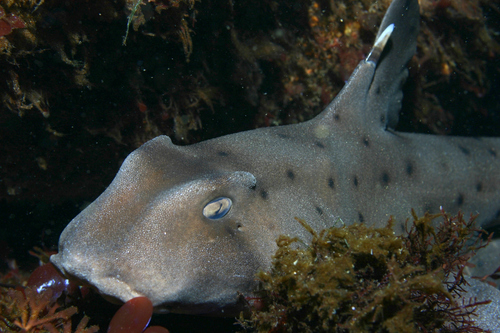
The horn shark (Heterodontus francisci) is a species of bullhead shark, in the family Heterodontidae. It is endemic to the coastal waters off the western coast of North America, from California to the Gulf of California. Young sharks are segregated spatially from the adults, with the former preferring deeper sandy flats and the latter preferring shallower rocky reefs or algal beds. A small species typically measuring 1 m (3.3 ft) in length, the horn shark can be recognized by a short, blunt head with ridges over its eyes, two high dorsal fins with large spines, and a brown or gray coloration with many small dark spots.

Slow-moving, generally solitary predators, horn sharks hunt at night inside small home ranges and retreat to a favored shelter during the day. Their daily activity cycles are controlled by environmental light levels. Adult sharks prey mainly on hard-shelled molluscs, echinoderms, and crustaceans, which they crush between powerful jaws and molar-like teeth, while also feeding opportunistically on a wide variety of other invertebrates and small bony fishes. Juveniles prefer softer-bodied prey such as polychaete worms and sea anemones. The shark extracts its prey from the substrate using suction and, if necessary, levering motions with its body. Reproduction is oviparous, with females laying up to 24 eggs from February to April. After laying, the female picks up the auger-shaped egg cases and wedges them into crevices to protect them from predators.

Appearance

Like other bullhead sharks, the horn shark has a short, wide head with a blunt snout and prominent supraorbital ridges over the eyes. The horn shark's supraorbital ridges are low and terminate abruptly; the space between them on top of the head is deeply concave. Each eye lacks a nictitating membrane and is followed by a tiny spiracle. The nostrils are split into inflow and outflow openings by a long flap that reaches the mouth. The inflow openings are encircled by a groove, while another groove connects the outflow openings to the mouth. The mouth is small and curved, with prominent furrows at the corners. There are 19–26 tooth rows in the upper jaw and 18–29 tooth rows in the lower jaw. The teeth at the front of the jaws are small and pointed, with a central cusp flanked by a pair of lateral cusplets; those at the sides of the jaws are much larger, elongated lengthwise, and molar-like.
Habitat

The horn shark inhabits the continental shelf of the eastern Pacific Ocean, occurring off the coasts of California and Baja California from Monterey Bay southward, and in the Gulf of California. Uncommon influxes of warm water northward may bring it as far as San Francisco Bay. There are unconfirmed reports of this species off Ecuador and Peru, which may be misidentifications of other species.

Diet

95% of the adult horn shark's diet consists of hard-shelled mollusks (e.g. bivalves and gastropods), echinoderms (e.g. sea urchins) and crustaceans (e.g. crabs, shrimp, and isopods). To crack their shells, the horn shark generates the highest known bite force relative to its size of any shark, well in excess of other measured species such as the spiny dogfish (Squalus acanthias) and the blacktip shark (Carcharhinus limbatus). One study found the average bite force for this species in the wild to be 95 N with a maximum of 135 N, while under experimental conditions sharks could be induced to bite with over 200 N of force. Large horn sharks that feed mainly on sea urchins (particularly the short-spined purple urchin, Strongylocentrotus purpuratus) have their teeth and fin spines stained purple.

Behaviour

The horn shark is a sporadic swimmer that prefers to use its flexible, muscular pectoral fins to push itself along the bottom. It is usually solitary, though small groups have been recorded. During the day, horn sharks rest motionless, hidden inside caves or crevices, or within thick mats of algae, though they remain relatively alert and will swim away quickly if disturbed. After dusk, they roam actively above the reef in search of food. Horn sharks maintain small home ranges of around 1,000 m2 (11,000 ft2), which they may remain faithful to for over a decade, returning to the same shelter every day. The shelter is usually located at the edge of the resident shark's foraging area. The longest documented movement for an individual horn shark is 16 km (9.9 mi).

Humans & conservation

Under normal circumstances, horn sharks are harmless to humans and can readily be approached underwater. However, they can be provoked into biting, and some pugnacious individuals have been known to chase and bite divers after being harassed. These sharks should be handled with care as their fin spines can inflict a painful wound. The horn shark adapts well to captivity and has been maintained and bred in many public aquariums across the United States. In July 2018, three people were arrested after stealing a juvenile horn shark from the San Antonio Aquarium. The shark was smuggled out of the aquarium in a stroller under a blanket. It was returned unharmed two days later.

Part of

Where to see it

No dive sites list Horn Shark yet. Explore the map to find sites near you.