
← All marine life
Hermit Crab
Group

Hermit Crab

Paguroidea, Latreille, 1802

marinebrackishfreshwater

About Hermit Crab

Hermit crabs are anomuran decapod crustaceans of the superfamily Paguroidea that have adapted to occupy empty scavenged gastropod shells to protect their fragile abdomens. There are over 800 species of hermit crab, most of which possess an asymmetric abdomen concealed by a snug-fitting shell. Hermit crabs' soft (non-calcified) abdominal exoskeleton means they must occupy shelter produced by other organisms or risk being defenseless.

The strong association between hermit crabs and their shelters has significantly influenced their biology. Almost 800 species carry mobile shelters (most often calcified snail shells); this protective mobility contributes to the diversity and multitude of these crustaceans, which are found in almost all marine environments. In most species, development involves metamorphosis from symmetric, free-swimming larvae to morphologically asymmetric, benthic-dwelling, shell-seeking crabs. Such physiological and behavioral extremes facilitate a transition to a sheltered lifestyle, revealing the extensive evolutionary lengths that led to the superfamily's success.

Appearance

Hermit crab species range in size and shape, from species only a few millimeters long to Coenobita brevimanus (Indos Crab), which can approach the size of a coconut and live 12–70 years. The shell-less hermit crab Birgus latro (coconut crab) is the world's largest terrestrial invertebrate.

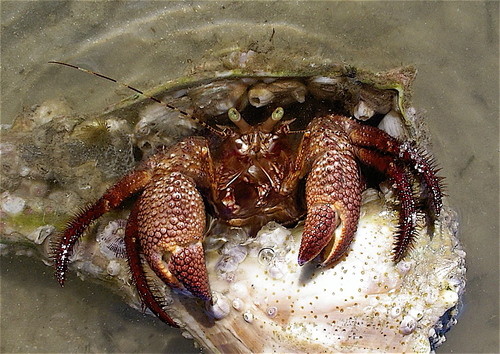
Most species have long, spirally curved abdomens, which are soft, unlike the hard, calcified abdomens seen in related crustaceans. The abdomen is protected from predators by a salvaged empty seashell carried by the hermit crab, into which its whole body can retract. Most frequently, hermit crabs use the shells of sea snails (although the shells of bivalves and scaphopods and even hollow pieces of wood and stone are used by some species). The tip of the hermit crab's abdomen is adapted to clasp strongly onto the columella of the snail shell.
Behaviour

Aggressive behaviors for hermit crabs are quite similar, with some variation between species. It usually consists of moving or positioning the legs and the chelipeds, also known as the claw or pincer. Usually these displays are enough to avoid confrontation. Sometimes two opposing crabs perform multiple actions, with no apparent pattern. The confrontations usually last a few seconds, though some may last a few minutes.

Reproduction

Hermit crab young develop in stages, with the first two (the nauplius and protozoea) occurring inside the egg. Most hermit crab larvae hatch at the third stage, the zoea. In this larval stage, the crab has several long spines, a long, narrow abdomen, and large fringed antennae. Several zoeal moults are followed by the final larval stage, the megalopa.

The sexual behavior exhibited by hermit crabs varies from species to species. But a broad description is as follows, if the female possesses any larvae from a previous mating, she moults and lets them go. Female hermit crabs are ready to mate shortly before moulting. In certain species the male grabs the pre-moult female for sometimes hours to days. During the time in which the female molts the male may engage in movements such as jerking or shaking the female towards the male before reproduction.

Species in this group

Where to see it

No dive sites list Hermit Crab yet. Explore the map to find sites near you.