
← All marine life
Haddock
Species IUCN · Vulnerable (VU)

Haddock

Melanogrammus aeglefinus, (Linnaeus, 1758)

marine

About Haddock

The haddock (Melanogrammus aeglefinus) is a saltwater ray-finned fish from the family Gadidae, the true cods. It is the only species in the monotypic genus Melanogrammus. It is found in the North Atlantic Ocean and associated seas, where it is an important species for fisheries, especially in northern Europe, where it is marketed fresh, frozen and smoked; smoked varieties include the Finnan haddie and the Arbroath smokie. Other smoked versions include long boneless, the filleted side of larger haddock smoked in oak chips with the skin left on the fillet.

Appearance

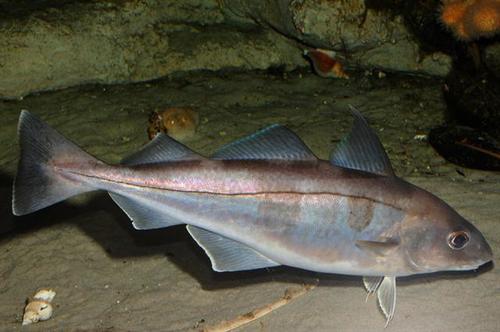
The haddock has the elongated, tapering body shape typical of members of the cod family. It has a relatively small mouth which does not extend to below the eye; with the lower profile of the face being straight and the upper profile slightly rounded, this gives its snout a characteristic wedge-shaped profile. The upper jaw projects beyond the lower more so than in the Atlantic cod. There is a rather small barbel on the chin. There are three dorsal fins, the first being triangular in shape and these dorsal fins have 14 to 17 fin rays in the first, 20 to 24 in the second, and 19 to 22 in the third. There are also two anal fins and in these there are 21 to 25 fin rays in the first and 20 to 24 fin rays in the second. The anal and dorsal fins are all separated from each other. The pelvic fins are small with an elongated first fin ray.
Habitat

The haddock has populations on either side of the north Atlantic but it is more abundant in the eastern Atlantic than it is on the North American side. In the north-east Atlantic it occurs from the Bay of Biscay north to Spitzbergen; however, it is most abundant north of the English Channel. It also occurs around Novaya Zemlya and the Barents Sea in the Arctic. The largest stocks are in the North Sea, off the Faroe Islands, off Iceland and the coast of Norway but these are discrete populations with little interchange between them. Off North America, the haddock is found from western Greenland south to Cape Hatteras, but the main commercially fished stock occurs from Cape Cod and the Grand Banks of Newfoundland.

Diet

Haddock is very popular as a food fish. It is sold fresh or preserved by smoking, freezing, drying, or to a small extent canning. Haddock, along with Atlantic cod and plaice, is one of the most popular fish used in British fish and chips. When fresh, the flesh of haddock is clean and white and its cooking is often similar to that of cod. A fresh haddock fillet will be firm and translucent and hold together well but less fresh fillets will become nearly opaque. Young, fresh haddock and cod fillets are often sold as scrod in Boston, Massachusetts; this refers to the size of the fish which have a variety of sizes, i.e., scrod, markets, and cows. Haddock is the predominant fish of choice in Scotland in a fish supper. It is also the main ingredient of Norwegian fishballs (fiskeboller).

Humans & conservation

Haddock is fished year-round using gear such as Danish seine nets, trawlers, long lines and gill nets and is often caught in mixed species fishery with other groundfish species such as cod and whiting. The main fishing grounds in the eastern Atlantic are in the Barents Sea, around Iceland, around the Faeroe Islands, in the North Sea, Celtic Sea, and in the English Channel. Landings in the eastern Atlantic have fluctuated around 200–350 thousand tonnes in the period 1980–2017. During the 1980s, the largest portion of the catch was taken at Rockall but from about 2000, the majority of the catch is caught in the Barents Sea. All the stocks in eastern Atlantic are assessed by ICES, which publish a recommendations on an annual basis for Total Allowable Catch.

Part of

Where to see it

No dive sites list Haddock yet. Explore the map to find sites near you.