
← All marine life
Guineafowl Puffer
Species IUCN · Least Concern (LC)

Guineafowl Puffer

Arothron meleagris, (Anonymous, 1798)

marine

About Guineafowl Puffer

Arothron meleagris, commonly known as the guineafowl puffer or golden puffer, is a pufferfish from the Indo-Pacific, and Eastern Pacific. It is occasionally caught for the aquarium trade. It reaches 50 centimetres (20 in) in length.

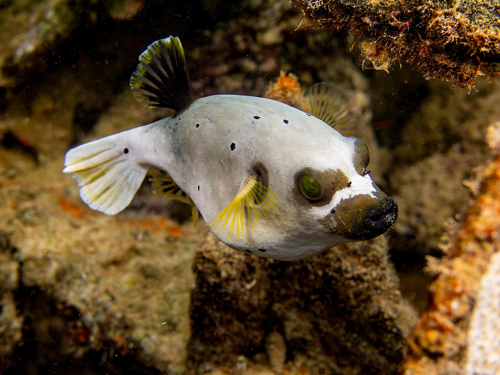
Guineafowl puffers have heavy rounded bodies that are uniformly black with numerous small white spots (black puffer or botete negro), bright yellow spots (golden puffer or botete dorado) or a mixture of the two morphologies with bright yellow spots and black patches. They have large blunt heads with short snouts and are equipped with a set of massive teeth. They have small and similarly shaped anal and dorsal fins that are well back on their body. Their caudal fin base is long and deep and their caudal fin is rounded. Their body is covered with small denticles that resemble coarse sandpaper.

When this fish is scared or frightened, they inflate and make themselves larger, exposing the denticles.

Appearance

A. meleagris has three main color phases. The most common color phase includes a dark brown background with many white spots on its whole body. The spots located on the rear of A. meleagris are more minuscule compared to the spots on its sides, a characteristic that is especially prevalent on those that are located in the Indian Ocean. The fins are usually dark brown with white spots and pale edges.

Another color phase is almost uniformly yellow, with a few black spots scattered around its body. The yellowish fins have white edges. The areas near its gills have a light brown patch.

The third color phase is intermediate between the dark phase and yellow phase, with a great degree of variation.

A survey of museum specimens found that 79% of individuals were dark phase, 10% were yellow phase, and 11% were in an intermediate phase.
Habitat

A. meleagris is distributed from the western Indian Ocean along the east coast of Africa, eastward through the Indian and Pacific Oceans to the west coast of Mexico, Colombia, Panama, and Ecuador in the eastern Pacific, north to the Ryukyu Islands, and south to Mangareva in the central Pacific and Easter Island in the south Pacific.

It is not found in the East-Indian area with the exception of the Christmas Island. A. meleagris can also be found in huge abundance within seafaring islands, residing at depths from 3–24 metres (10–80 ft).

Diet

While the diet of this species mainly consists of corals and invertebrates such as tunicates, crustose coralline algae, sponges and echinoids, it also varies according to the number of corals within different reefs, such as La Azufrada. In some areas, it acts as a passive generalist, eating corals that are dependent on their abundance, while in others, it acts as an active generalist, increasing its dietary preferences by only consuming uncommon corals.

Coral reefs are one of the most common foods that this species feeds on as they greatly assist with their growth. The availability of food types may affect its diet. This is due to the fact that the predation pressure applied by A. meleagris may rise or fall as the overall population of its prey shifts.

Humans & conservation

Arothron meleagris is highly abundant within the Indian Ocean and the eastern Pacific Ocean reefs while being less commonplace on the rocky reefs of the eastern Pacific. While its population saw a large increase from 1987 to 2002 in Costa Rica, it may be decreasing due to the destruction of its habitats.

Additionally, the marine aquarium trade may also have contributed to the decrease in the population of A. meleagris. This is because it is considered a high-priced product in the marine aquarium trade.

Part of

Where to see it

No dive sites list Guineafowl Puffer yet. Explore the map to find sites near you.