
← All marine life
Greater Weever
Species IUCN · Least Concern (LC)

Greater Weever

Trachinus draco, Linnaeus, 1758

marine

About Greater Weever

The greater weever (Trachinus draco) is a species of marine ray-finned fish in the family Trachinidae. It is a benthic fish widely distributed along the eastern Atlantic coastline (from Norway to Morocco), extending to the Mediterranean, Aegean and Black Seas. The greater weever is mostly and notoriously known for its venomous spines, which can inflict serious injuries on humans through accidental stinging. Because of this, the greater weever is classified as one of the most venomous fishes in the Mediterranean.⁠

Appearance

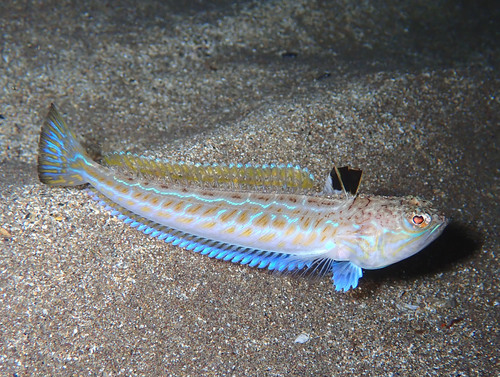
The greater weever is an elongated and laterally flattened fish with a distinct superior mouth that is inclined upwards. The lower jaw is longer than the upper jaw. The head is compact flat and relatively big and the eyes sit almost on top of it.⁠ The upper rim of the eye has two to three small spines, in front of each eye. The five to seven spiny fin rays on its first dorsal fin and the thorns on each of the gill covers have venom glands at their basis.⁠

Diet

The greater weever is an ambush predator that digs itself into fine sand during daytime, with only its eyes and the tip of the dorsal fin exposed.⁠ There it lurks until potential prey approaches, which it then attacks in a swift and sudden manner. At night, the greater weever is believed to swim around freely, even pelagically. This is supported by the finding that prey caught during daytime is already mostly digested by the night of the same day.⁠⁠⁠⁠

Behaviour

The greater weever has been shown to occur in depths ranging from shallow water up to 150 m (490 ft), where it inhabits mostly muddy or sandy grounds.

Reproduction

The reproduction period of the greater weever seems to begin in June and last until October.⁠ This very broad range is limited by the observations of Ole Bagge (2004), who states that his findings strongly indicate that the spawning time of is indeed restricted to the period between June and August with a peak in July. Bagge also says that there have been no findings of greater weever in spawning condition from September to May.⁠

The greater weever is oviparous and lays its eggs into the pelagic zone. ⁠Each egg has a size of about 4.8–6.8 mm (0.19–0.27 in)⁠ and hatches after approximately three months; the eggs and larvae can both be found in the pelagic zone and as a part of zooplankton. The eggs may have a need for relatively warm water with a relatively low salinity to hatch in greater numbers.⁠

Humans & conservation

The most common incident regarding humans is strongly connected with T. draco's typical behaviour: burrowing in the sand of shallow waters. Especially in the summer a bather may easily step, jump or fall onto the venomous spines of a buried greater weever. The other occasion where humans are at risk to get stung by T. draco is when fishermen are handling the fish if caught in a net.⁠⁠

Where to see it

No dive sites list Greater Weever yet. Explore the map to find sites near you.