
← All marine life
Greater Blue-Ringed Octopus
Species IUCN · Least Concern (LC)

Greater Blue-Ringed Octopus

Hapalochlaena lunulata, (Quoy & Gaimard, 1832)

marine

About Greater Blue-Ringed Octopus

The greater blue-ringed octopus (Hapalochlaena lunulata) is one of four species of extremely venomous blue-ringed octopuses belonging to the family Octopodidae. This particular species of blue-ringed octopus is known as one of the most toxic marine animals in the world.

Appearance

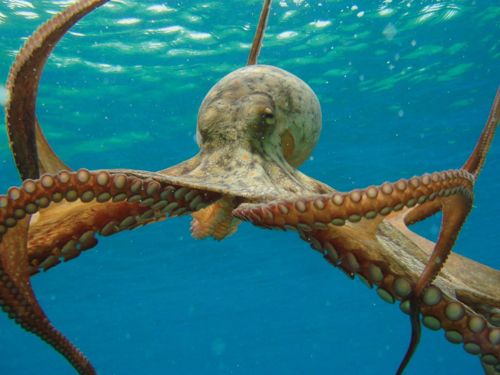
The greater blue-ringed octopus, despite its vernacular name, is a small octopus whose size does not exceed 10 centimetres (3.9 in), arms included, with an average weight of 80 grams (2.8 oz). Its common name comes from the relatively large size of its blue rings (7 to 8 millimetres [0.28 to 0.31 in] in diameter), which are larger than those of other members of the genus and help to distinguish this type of octopus. The head is slightly flattened dorsoventrally (front to back) and finished in a tip. Its eight arms are relatively short.
Habitat

The greater blue-ringed octopus is a benthic animal that has a solitary way of life and is widespread throughout the tropical and subtropical waters of the Indo-West Pacific, from Sri Lanka to the Philippines and from Australia to Papua New Guinea, the Solomon Islands and Vanuatu. The animal prefers shallow waters with a mixed seabed (such as rubble, reefs and sandy areas). As is true for all octopuses, it lives in a burrow and only comes out to search for food or a mate. The entrance of the shelter is littered with remains from meals (empty shells and crab shell and legs) and is easily identifiable.

Diet

The blue-ringed octopus diet typically consists of small crabs, shrimp and mollusks. They also tend to take advantage of small injured fish if they can catch them. Its known hunting behavior consists of pouncing on its prey, seizing it with its arms, and then pulling it towards its mouth. It uses its horny beak to pierce through the tough crab or shrimp exoskeleton, releasing its venom. The venom paralyzes the muscles required for movement, which effectively kills the prey.

Behaviour

The octopus usually flashes its iridescent rings as a warning signal, each flash lasting around a third of a second. To test the theory if blue-ringed octopodes could produce their own blue iridescence, scientists bathed the octopus samples in a wide range of chemicals that were known to affect chromatophores and iridophores. It was found that none of the chemicals used affected the octopuses' ability to produce its blue rings. It was also found that after examining the blue rings (specifically the iridophores) were seen to shift to the UV end of the spectrum which is a defining characteristic of multi-layer reflectors. It was also found that the iridophores are nicely tucked into the modified skin folds, kind of like pouches, which could be contracted by the muscles that connect the center of each ring to the rim.

Reproduction

The initiation of physical contact is completely independent from sex, size, or residency status which left no notable changes of behavior based on sex alone. However, spermatophores are only released during sexual interaction with females but not with males which indicates that upon copulation, the male can distinguish the difference on whether to inseminate or not. The copulation times between male-female are roughly 160.5 minutes, while the copulation times with the male-male interactions lasted about 30 seconds. Ultimately the studies that were conducted determined that until copulation occurs, prior to insertion of the hectocotylus, the male cannot determine the difference in sex.

Part of

Where to see it

No dive sites list Greater Blue-Ringed Octopus yet. Explore the map to find sites near you.