
← All marine life
Greater Amberjack
Species IUCN · Least Concern (LC)

Greater Amberjack

Seriola dumerili, (Risso, 1810)

marine

About Greater Amberjack

The greater amberjack (Seriola dumerili), also known as the allied kingfish, great amberfish, greater yellowtail, jenny lind, sea donkey, purplish amberjack, reef donkey, rock salmon, sailors choice, yellowtail, and yellow trevally, is a species of predatory ray-finned fish in the family Carangidae, the jacks and pompanos. It is found in temperate, subtropical, and tropical seas around the world. It is a popular quarry species for recreational fisheries and is important in commercial fisheries. It is the largest species in the family Carangidae.

Appearance

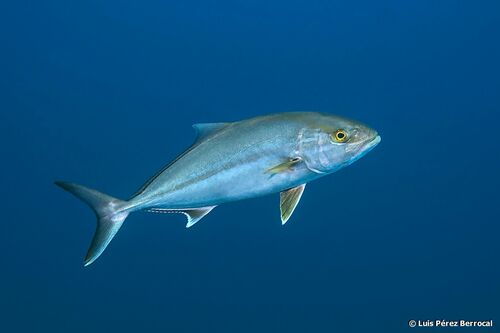
The greater amberjack is a large predatory fish which has a body colouring which varies from brownish to bluish-grey on the dorsal surfaces contrasting with the silvery-white underparts. A diagonal sooty stripe starts at the snout and runs along the centre of the back dorsal fin; another dark stripe runs from the upper jaw, across the eye to in front of the first dorsal fin. Some fish may show a light yellow to reddish-brown stripe along the flanks. The fins are dusky in colour. The second dorsal and anal fins have a low anterior lobe. Small juveniles have clear fins and a series of five vertical bands along the body and a sixth band on the caudal peduncle. The shape of the body is elongated and fusiform and it is of moderate depth and laterally compressed, and has a covering of small cycloid scales.

Habitat

The greater amberjack has an almost circumglobal distribution in the world's subtropical and tropical seas and oceans. In the Indian Ocean, it is found along the African coast from South Africa east through the Persian Gulf to Western Australia and southern Japan, reaching the Hawaiian Islands and Micronesia in the Pacific Ocean. It reaches as far south as the island of Tasmania off the coast of Australia. In the western Atlantic Ocean, this species is found around Bermuda and on the North American coast as far north as Nova Scotia extending south as far as Brazil, including the Gulf of Mexico and the Caribbean Sea. In the eastern Atlantic Ocean, it has been recorded as a vagrant as far north as the British Isles and is found off in the Bay of Biscay south to Morocco and in the Mediterranean Sea.

Diet

Greater amberjacks are opportunistic predators when they are adults, which prey on benthic and pelagic fishes, as well as cephalopods and crustaceans. Common fish prey species include the bigeye scad (Selar crumenophthalmus) and sardines (Sardinella aurita and Sardina pilchardus). The juvenile fish feed on plankton, including the larvae of decapods and other small invertebrates. The juveniles switch to feeding on larger prey such as larger benthic and nektonic organisms when they attain a length of 8–12 cm (3.1–4.7 in), and once they have grown larger than 12 cm (4.7 in), they restrict their prey choice to animals that swim on or over the substrate; when they attain 20 cm (7.9 in), they are mainly piscivorous and at this size, they move from open waters to more coastal areas.

Reproduction

S. dumerli is gonochoric, meaning that the males and females are separate and determined at birth, and no sexual dimorphism exists other than size. The sexes begin to differentiate around 4–5 months of age when they attain a length of 24–26 cm (9.4–10.2 in). In the Mediterranean, they reach sexual maturity at 4 (males) and 5 (females) years of age when they attain a length around 109 and 113 centimetres (43 and 44 in) in length in males and females. In western Atlantic populations, the males are mature after three years and 80 cm (31 in) and the females after four years of age and attaining 83 cm (33 in). This species has been observed to show pair courtship off Belize where schools numbering around 120 individuals were found and pairing mainly occurred during when the Moon was either full or waning and between February and October.

Humans & conservation

The greater amberjack is an important food fish and is a commercial quarry species, and the species has been used in aquaculture in the Mediterranean since the 1980s. As a predatory fish, it requires protein and lipids sourced from other fish, so questions have arisen over the sustainability of its culture. It is also a popular game species for angling, having earned the nickname "reef donkey" for its stubborn fight. The meat is used for sushi and sashimi in Japan, while in Florida and Mexico, its flesh is marketed fresh and can be fried, broiled, baked, or grilled. Angling techniques used to catch greater amberjacks include trolling at the surface with various artificial lures and natural baits. They are often incidentally caught by anglers who are fishing the seabed for snappers and groupers.

Part of

Where to see it

No dive sites list Greater Amberjack yet. Explore the map to find sites near you.