
← All marine life
Goldsilk Seabream
Species IUCN · Least Concern (LC)

Goldsilk Seabream

Acanthopagrus berda, (Forsskål, 1775)

marinebrackishfreshwater

About Goldsilk Seabream

Acanthopagrus berda, the goldsilk seabream, sly bream, picnic seabream, black sea bream, black porgy, picky bream, silver bream or river bream, is a species of ray-finned fish belonging to the family Sparidae, the sea breams and porgies. This species is found in the Indian Ocean.

Appearance

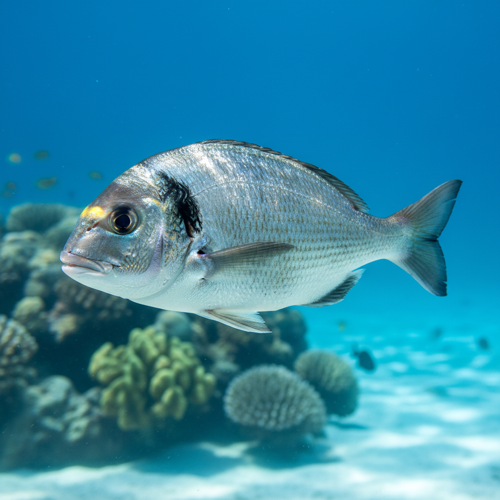
Acanthopagrus berda has a relatively deep and compressed body with the depth of its body fitting into its standard length between 2.4 and 2.6 times. The dorsal fin is supported by 11 or 12 spines, while the anal fin has 3 spines, with the second spine being longer than the third, and 8 or 9 soft rays. There are robust molar-like teeth along both jaws, the rows of these teeth are clearly curved laterally at the back of the lower jaw. It is dark olive brown on the upper body, becoming very black when the fish is stressed or excited, much paler on the lower body with metallic tints. This species has a maximum published total length of 90 cm (35 in), although 35 cm (14 in) is more typical.
Habitat

Acanthopagrus berda is found in the Indian Ocean. It is found along the eastern coast of Africa from the Egypt, Israel and Jordan south to the Eastern Cape of South Africa and Madagascar, east along the Asian coast to Peninsular Malaysia, Singapore and Sumatra. There are claims from freshwater in southern Africa but these are unconfirmed, although it has been recorded in freshwater in Madagascar, and records from the Persian Gulf are thought to be misidentifications of A. randalli. The goldsilk sea bream is dependent on estuaries and is found on areas of sand and mud substrates as deep as 50 m (160 ft). Juveniles and subadults are found in sheltered bays and estuaries.

Humans & conservation

Acanthopagrus berda is a popular species for recreational anglers which does not seem to be subjected to heavy fishing pressure. It is fished for by artisanal fisheries in India. This species is being studied for its potential for aquaculture in India.

Part of

Where to see it

No dive sites list Goldsilk Seabream yet. Explore the map to find sites near you.