
← All marine life
Golden Trevally
Species IUCN · Least Concern (LC)

Golden Trevally

Gnathanodon speciosus, (Forsskål, 1775)

marine

About Golden Trevally

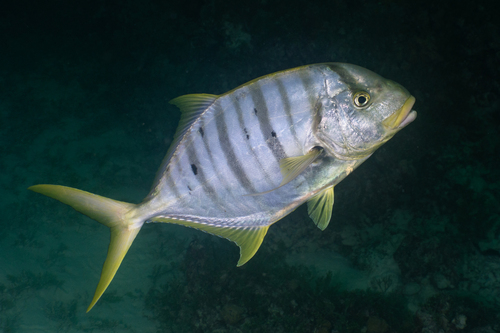
The golden trevally (Gnathanodon speciosus), also known as the golden kingfish, banded trevally or king trevally, is a species of large marine fish classified in the jack and horse mackerel family Carangidae, and the only member of the monospecific genus Gnathanodon. The golden trevally is widely distributed throughout the tropical and subtropical waters of the Indian and Pacific Oceans, ranging from South Africa in the west to Central America in the east, extending to Japan in the north and Australia in the south. The species predominantly occupies inshore waters where it inhabits both reef and sandy substrates.

Appearance

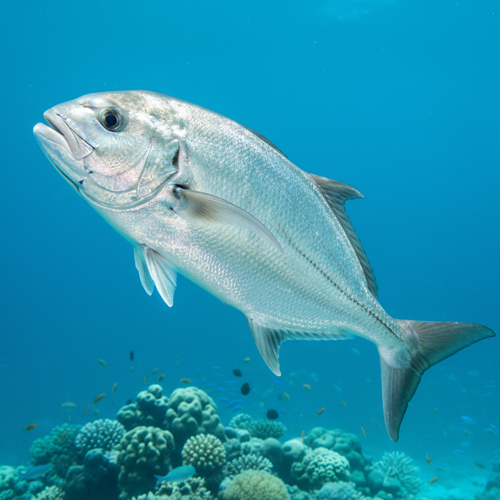
The golden trevally is a relatively large fish, growing to a maximum recorded size of 120 cm (47 in) in length and 15.0 kg in weight. It is similar to most other trevallies and jacks in having a compressed, oblong body, with the dorsal profile slightly more convex than the ventral profile, particularly anteriorly. The species' mouth is one of its defining features; the mouth is highly protractile and fleshy, with specimens greater than 90 mm having no teeth on the jaws, vomer or tongue. Smaller individuals have a series of small villiform teeth in both jaws. The dorsal fin is in two parts, the first with 7 spines, the second with 1 spine and 18 to 20 soft rays. The anal fin has 2 detached spines followed by 1 spine and 15 to 17 soft rays, while the pelvic fin consists of 1 spine and 19 to 20 soft rays.
Habitat

The golden trevally is widely distributed throughout the tropical and subtropical waters of the Indian and Pacific Oceans. In the Indian Ocean, the species is distributed from South Africa along the east African coastline, including the Red Sea and Persian Gulf. Its distribution extends east along the Indian and South East Asian coastlines, and south through Indonesia and northern Australia. Golden trevally are recorded from many Indian Ocean islands including Madagascar, Seychelles and The Maldives. In the Pacific, the species is spread throughout the South East Asian and Indonesian archipelago north mainland China and Japan and south to eastern Australia and New Zealand. Golden trevally have been recorded from many central Pacific Islands, including Hawaii, with their distribution extending to Central America.

Diet

The golden trevally is a diurnal foraging carnivore which, unlike other carangids, does not normally seek out individual prey items. The highly protractile mouth possessed by the species is used to form a tube to suck prey out of both reef- and algae-dominated habitats, as well as filtering organisms out of sandy substrates. In the latter case, both sand and any prey items are taken into the mouth and filtered through the gill rakers; sand is expelled, while small organisms are trapped and swallowed. The species takes a variety of prey including crustaceans such as shrimp, crabs, and amphipods, as well as molluscs, other fossorial invertebrates in the sand, and small fish. Golden trevally found inhabiting a mangrove swamp were found to have fed exclusively on fish (Mugil curema), suggesting the species also actively hunts down fleeing prey.

Behaviour

The golden trevally is found either as a solitary individual or in small schools as an adult. Juveniles tend to form larger schools which tend to congregate and follow ( or "pilot") larger fish such as groupers, sharks, and even jellyfish. This behaviour mimics that of the related pilot fish, Naucrates ductor, with their maneuverability protecting them from their hosts, which in turn provides them with protection from predation from other fish. This behaviour extends to scuba divers, with one diver reporting a single young individual obsessively stationing itself in front of his face plate.

Reproduction

Reproduction in the golden trevally has been studied in both the Indian and Pacific Oceans. In Hawaii, spawning occurred from late February to early October, with a peak from late April to early September. Five distinct peaks during this time were correlated with the first and third quarters of the moon. Spawning occurred from the early evening into the night. In the Indian Ocean, in the southern Persian Gulf, spawning occurred in April and May, with defined peaks in recruitment of juveniles into the local fishery during September and October. The male:female sex ratio in this population was 1:1.01, close to parity. Growth rates were also studied using otoliths in this population, with an increase in growth rate during the winter (November to April). Von Bertalanffy growth curves were also calculated for the species.

Humans & conservation

The golden trevally has long been used as a food fish by humans, with archeological sites in the United Arab Emirates yielding the remains of this species dating back to prehistory. The species is still fished for using many traditional methods in the Pacific Islands, where it is netted and speared when it moves to shallower waters. Golden trevally are considered one of the best members of the trevally family for eating, with bleeding being recommended. The fish has slightly translucent, dark-pink flesh while fresh, becoming white and juicy during cooking, although has a tendency to become dry, flaky, and fibrous. A rich, tangy fish flavour is noted.

Part of

Where to see it

No dive sites list Golden Trevally yet. Explore the map to find sites near you.