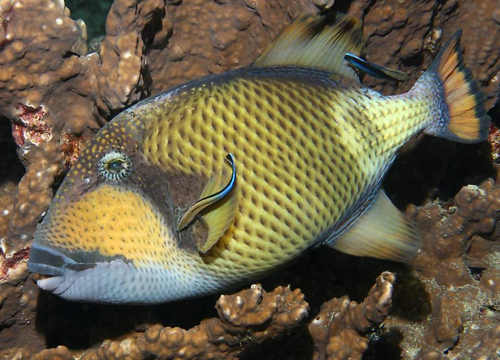
Appearance
The gilded triggerfish is a spotted brownish-gray triggerfish, although sometimes there is a bluish or lavender tint. It has a laterally compressed body, a small upturned mouth, and an emarginate caudal fin.


Xanthichthys auromarginatus, (Bennett, 1832)
The gilded triggerfish or blue-throated triggerfish (Xanthichthys auromarginatus) is a species of marine ray-finned fish in the triggerfish family Balistidae. It is found in the Indo-Pacific region.
The gilded triggerfish is a spotted brownish-gray triggerfish, although sometimes there is a bluish or lavender tint. It has a laterally compressed body, a small upturned mouth, and an emarginate caudal fin.
The gilded triggerfish can be found in the waters of the Indo-Pacific region, spanning from Eastern Africa in the western Indian Ocean to the Hawaiian islands longitudinally, and latitudinally from the Ryukyu Islands to New Caledonia. In particular, specimens have been found around the Maldive Islands, the Nicobar Islands, the islands of Micronesia and the Marshall Islands (first in 1978, at Kwajalein Atoll). Similar to most other triggerfish, this species can be located off of islands and reefs, but it may also venture out to more open waters.
While the usual depth range is between 20–50 m, the glided triggerfish may be spotted anywhere between 8–161 m. This fish is typically found toward the deeper end of the usual range, with it being rarer to find in depths above 20 m. Despite its preference for deeper depths, scuba divers can frequently spot this fish at recreational diving depths.
Through examining the stomach contents of the gilded triggerfish, it was determined that their diet consisted exclusively of zooplankton, primarily calanoid copepods.
Reproduction in all species of the triggerfish family is roughly the same: through oviparity and consisting of a single male and female. The preferred spawning site is sandy substrates on reefs, with the usual spawning time being the early morning. A single female can release between 55,500 and 430,000 eggs during spawning, which happens in seconds, with the pair touching their abdomens and releasing the gametes into the water. Fertilized eggs attach to sand particles on the sea floor and are about 0.47–0.55 mm in diameter. Hatching of the eggs typically occurs in the evening of the day when they were laid. Both maternal and biparental care have been documented in the triggerfish family.
According to the IUCN Red List, the gilded triggerfish is considered a species of Least Concern (LC), as it is a widely distributed fish with no known major threats that could lead to a population decline. Henceforth, there are no conservation measures taking place for this species.
No dive sites list Gilded Triggerfish yet. Explore the map to find sites near you.