
← All marine life
Giant Sea Bass
Species IUCN · Critically Endangered (CR)

Giant Sea Bass

Stereolepis gigas, Ayres, 1859

marine

About Giant Sea Bass

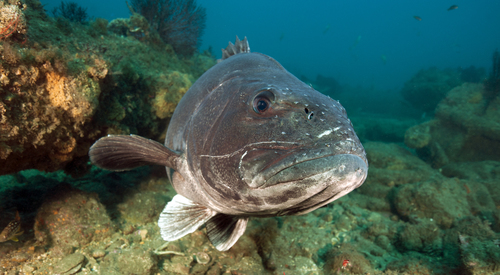
The giant sea bass (Stereolepis gigas) is a fish native to the North Pacific Ocean. Although commonly referred to as a giant sea bass, black sea bass or giant black sea bass, it is unrelated to sea basses in the family Serranidae.

Appearance

There are published reports of giant sea bass exceeding 2.1 metres (7 ft) in length. A 2014 study by Hawk and Allen found specimens up to 2.003 metres (6 ft 6.9 in) long. As growth in the giant sea bass slows with increasing age, the study also reported that the Von Bertalanffy function predicts a maximum length of 2.0622 metres (6 ft 9.19 in) at an indefinite age. Reports of giant sea bass weighing as much as 600 pounds (270 kg) cannot be verified. A specimen weighing 435 pounds (197 kg) was reported in 1971. Aside from its tremendous size, the giant sea bass is also known for its lengthy lifespan. They mature around the age of 11 or 12, around the weight of 50 pounds (23 kg).

Habitat

In the eastern North Pacific, its range is from Humboldt Bay, California, to the Gulf of California, Mexico, most common from Point Conception southward. In the northwestern Pacific it occurs around Japan.

It usually stays near kelp forests, drop-offs, or rocky bottoms and sand or mudflats. Juvenile giant sea bass can be found at depths around 69 feet (21 m), with adults of the species found at depths below 66 feet (20 m).

Diet

Within kelp forests giant sea bass are the apex predator. Giant sea bass feed on crustaceans, as well as a wide variety of fish. For populations off the coast of California, anchovies and croaker are prominent food sources. Mackerel, sheephead, whitefish, sand bass, and several types of crab also make up the sea bass's diet. Despite their great size and bulky appearance, giant sea bass have been known to move extremely quickly, outstripping bonito.

Humans & conservation

Recreational fishing of the giant sea bass began in the late 19th century. Caught off the Central and Southern California coasts in the 20th century, the peak catch of the giant sea bass was in 1932. Once relatively common in Southern California waters, the fish was facing the threat of local extinction there by the 1980s.

Giant sea bass were also a popular "big game" quarry for both freediving and scuba spearfishermen. In the 1970s, spearfishing for this species was made illegal by the California Department of Fish and Game. One notable incident precipitated an abrupt change in the law. Several freedivers had taken seven fish at Santa Cruz Island. They then sold the catch illegally to a fish market in San Pedro. Fish and Game wardens discovered that the fish had been speared by observing the holes and slip tips left behind in their bodies.

Where to see it

No dive sites list Giant Sea Bass yet. Explore the map to find sites near you.