
← All marine life
Giant Kelpfish
Species IUCN · Least Concern (LC)

Giant Kelpfish

Heterostichus rostratus, Girard, 1854

marine

About Giant Kelpfish

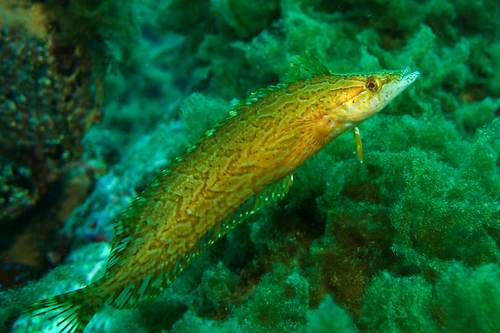
The giant kelpfish (Heterostichus rostratus) is a 10–24 inches (25–61 cm) species of marine fish, and the largest member of the family Clinidae. It is currently the only known member of its genus.

Appearance

The giant kelpfish has an eel-like, elongated, and compressed body with a pointed head and small, terminal mouth. Its dorsal fin is continuous along the entire top length of the body, ending at the caudal peduncle. The dorsal fin consists of a small section of vertically longer spiny rays close to the head and a soft ray portion connected to the spiny rays.

The pectoral fins are rounded and short while the pelvic fins are small and thin. It has a very long, broad and continuous anal fin, and a forked tail. It has small cycloid scales covering its body used for protection and hydrodynamics.
Habitat

The giant kelpfish is native to the west coast of North America. It is found most commonly in the warmer waters of Point Conception, California, to southern Baja California. It inhabits rocky areas with dense canopies of giant kelp and other large seaweeds. It is also known that they may use eelgrass or surfgrass as a substitute for their preferred habitat of understory algae. Juveniles have been observed to utilize the upper portions of macroalgae while the older individuals gather near the base of the plant. They prefer to live near the surface to moderately deep waters due to the abundance of sunlight and in turn, dense vegetation for their nests and protection.

Diet

The giant kelpfish is a carnivorous bottom-feeding species. Its diet consists of small crustaceans, mollusks, and other fishes. It has a terminal mouth, a characteristic of ambush predators. Kelpfish larvae eat items such as single celled algae and mollusk larvae.

Reproduction

The giant kelpfish is oviparous, as opposed to some other members of the Clinidae family that are viviparous and bear live young. Giant kelpfish spawn all year, but most often in the spring. Spawning has been recorded to take about 40–60 minutes. Eggs are carried and deposited in the nest by the female, while the male chases away any potential intruders. The male comes in to fertilize the eggs various times throughout this process and immediately after, returns to guarding. The male's territory consists of the oviposition site and is guarded heavily when eggs are present and sparsely when they are not.

Humans & conservation

According to the IUCN, the giant kelpfish is of least concern, but nonetheless faces many human-induced pressures. A potential threat that may arise is loss of habitat due to climate change and its resulting consequences such as ocean acidification and pollution, as well as destruction and/or massive die-offs of kelp forests. This poses a threat because this species depends on dense canopies of kelp for protection from predators and for reproduction. They may also be threatened by invasive species and the overharvesting of kelp for human use.

Part of

Where to see it

No dive sites list Giant Kelpfish yet. Explore the map to find sites near you.