
← All marine life
Garibaldi
Species IUCN · Least Concern (LC)

Garibaldi

Hypsypops rubicundus, (Girard, 1854)

marine

About Garibaldi

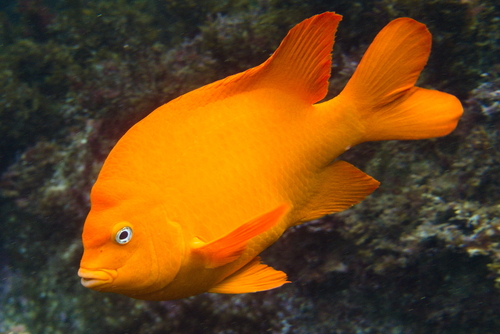
The Garibaldi (Hypsypops rubicundus), known historically as the Catalina goldfish and marine goldfish and now commonly as the Garibaldi damselfish, is a species of bright orange fish in the damselfish family. It occurs in the subtropical northeastern part of the Pacific Ocean. The Garibaldi was named the official marine state fish of California in 1995, and has since been protected in California coastal waters from recreation and commercial fishing.

The English name is a reference to the 19th-century Italian general and political figure Giuseppe Garibaldi, whose followers often wore a characteristic scarlet or red shirt. Male Garibaldis aggressively defend the nest site after the female lays eggs, as is the case with other damselfish.

Appearance

Garibaldi are deep-bodied or laterally compressed fish, and covered in coarse scales. They have a single dorsal fin with about 12 spines and 16 rays. Adult fish of this species are uniformly bright orange in color. It is the largest member of the damselfish family growing up to 35.6 cm (14 inches) in length. Among Garibaldi there is a sexual size dimorphism, with average adult males measuring 25 mm (1 inch) larger than females,⁠ — an unusual trait for damselfish species and other marine fish in southern California, where typically adult females are larger.

Juveniles are a deeper, more reddish shade of orange than adults. They are covered in many small iridescent blue stripes and spots, which they gradually lose as they become adults. Their tail (caudal fin) and dorsal fins are more translucent compared to their adult counterparts.

Habitat

Garibaldis are found in marine waters up to 30 metres (98 ft) in depth. They usually nest in association with rock reefs and typically over rocky sea-bottoms. They prefer to live over rocky bottoms on exposed or semi-protected coasts with clear water and plenty of crevices as well as small caves for cover. Juveniles can be found in tide pools up to depths of 40 feet (just over 12 m). H. rubicundus is native to subtropical parts of the northeastern Pacific Ocean, ranging from Monterey Bay, California, to Guadalupe Island, Baja California.

Diet

Classified as generalist omnivores, Garibaldi feed mainly on invertebrates, which they remove from the rocks. Their diet also includes a variety of algae and occasionally their own eggs. Garibaldi are found to most commonly feed upon fleshy red algae, polychaete worms, anemones, and sponge fragments. But they have also been found to eat encrusting bryozoans, hydroids, branching bryozoans, mollusks, and brown algae.

Behaviour

Unlike other damselfish where males guard nest sites only during the mating season, both male and female adult Garibaldi tend to defend year-round territories of about 3-10 square meters, demonstrating a strong attachment to their specific locations. Males are more strict with defense, especially during the breeding season. During the time period that the eggs are developing, the male Garibaldi aggressively tries to keep all other fish away from the eggs, and will boldly attack much larger swimming creatures, including humans, to the point of biting divers in order to try to drive them away from the area where the eggs are deposited. Garibaldi territories include a shelter hole, foraging area, and for adult males, a nest site consisting of perennial patches of red algae cultivated by the male.

Humans & conservation

The IUCN Red List of Threatened Species lists Garibaldi as Least Concern. Due in part to the species being widespread in the Eastern Pacific, common in many parts of its range with no major threats, and no current indication of population decline.

A brand new study Fuentes Calderon et al., 2024, has data that shows correlated patterns between sea surface temperature across islands and the relationship between diet composition and habitat type. It is hard to find direct evidence of habitat-related differences in the ecological performance of marine fishes, but this knowledge can be critically important in the future design and assessment of projects that may add or remove reef habitats in the ocean.

Part of

Where to see it

No dive sites list Garibaldi yet. Explore the map to find sites near you.