
← All marine life
Foureye Butterflyfish
Species IUCN · Least Concern (LC)

Foureye Butterflyfish

Chaetodon capistratus, Linnaeus, 1758

marine

About Foureye Butterflyfish

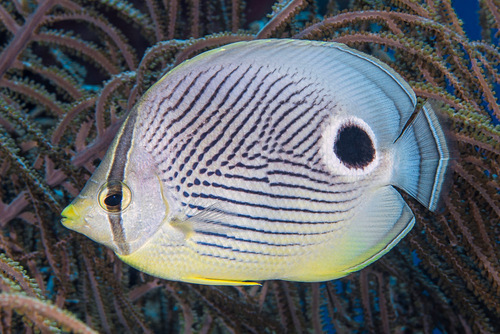
The foureye butterflyfish or four-eyed butterflyfish (Chaetodon capistratus) is a species of marine ray-finned fish in the butterflyfish family Chaetodontidae. This species is found in the Western Atlantic, from New England through Bermuda and the West Indies to northern South America.

Appearance

The foureye butterflyfish is deep-bodied and laterally compressed, with a single dorsal fin and a small mouth with tiny, bristle-like teeth. The body is light grey, sometimes with a yellowish hue, on which there are many forward-pointing dark chevrons. At the rear portion of each side of the body, the chevrons are replaced by a white-margined black ocellus (which is vertically oval in juveniles and more circular in adults); this feature leads to the common name of this species. The two ocelli are much more visible than the true eyes, which are smaller and are run through by a black vertical bar. Similar to the other butterflyfish species with the ocellus feature, this pattern is an instance of automimicry, and is designed to disorientate predators and make them think that the rear of the fish is actually the front.
Diet

The foureye butterflyfish usually frequents shallow inshore waters, where it feeds on a variety of invertebrates, mainly zoantharians, sea anemones, scleractinians, polychaete worms, gorgonians, tunicates and crustaceans. It may also eat fish eggs. Like its relatives, the foureye butterflyfish mates for life, and so is often seen in pairs. This behavior is rare among fishes.

Behaviour

Other potential functions of the ocelli may exist. These include: intimidating prey, altering predation reaction distances, serving as a general warning and social communication.

Part of

Where to see it

No dive sites list Foureye Butterflyfish yet. Explore the map to find sites near you.