
← All marine life
Feather Star
Group

Feather Star

Crinoidea, Miller, 1821

marine

About Feather Star

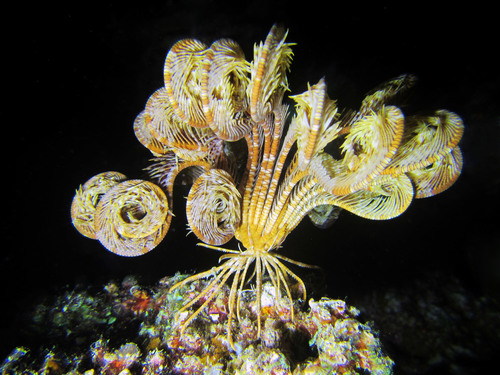
Crinoids are marine invertebrates that make up the class Crinoidea. Crinoids that remain attached to the sea floor by a stalk in their adult form are commonly called sea lilies, while the unstalked forms, called feather stars or comatulids, are members of the largest crinoid order, Comatulida. Crinoids are echinoderms in the phylum Echinodermata, which also includes the starfish, brittle stars, sea urchins, and sea cucumbers. They live in both shallow water and at depths over 9,000 m (30,000 ft).

Adult crinoids are characterised by having their mouths located on their upper surface. This is surrounded by feeding arms and is linked to a U-shaped gut, with the anus being located on the oral disc near the mouth. Although the basic echinoderm pattern of five-fold symmetry can be recognised in most crinoids, the five arms are subdivided into 10 or more. These have feathery pinnules and are spread wide to gather planktonic particles from the water. At some stage in their lives, most crinoids have a short stem used to attach themselves to the substrate, but many live attached only as juveniles and become free-swimming as adults.

Only about 700 living species of crinoids are known, but the class was much more abundant and diverse in the past. Some thick limestone beds dating to the mid-Paleozoic era to Jurassic period are composed almost entirely of disarticulated crinoid fragments.

Appearance

The basic body form of a crinoid is a stem (not present in adult feather stars) and a crown consisting of a cup-like central body known as the theca, and a set of five rays or arms, usually branched and feathery. The mouth and anus are both located on the upper side of the theca, making the dorsal (upper) surface the oral surface, unlike in the other echinoderm groups such as the sea urchins, starfish, and brittle stars, where the mouth is on the underside. Numerous calcareous plates make up the bulk of the crinoid, with only a small percentage of soft tissue. These ossicles fossilize well and some beds of limestone date from the Lower Carboniferous around Clitheroe, England, formed almost exclusively from a diverse fauna of crinoid fossils.

Diet

Crinoids are passive suspension feeders, filtering plankton and small particles of detritus from the sea water flowing past them with their feather-like arms. The arms are raised to form a fan shape, which is held perpendicular to the current. Mobile crinoids move to perch on rocks, coral heads, or other eminences to maximise their feeding opportunities. The food particles are caught by the primary (longest) tube feet, which are fully extended and held erect from the pinnules, forming a food-trapping mesh, while the secondary and tertiary tube feet are involved in manipulating any encountered food.

Reproduction

Crinoids are dioecious, with individuals being either male or female. In most species, the gonads are located in the pinnules, but in a few, they are located in the arms. Not all the pinnules are reproductive, just those closest to the crown. The gametes are produced in genital canals enclosed in genital coeloms. The pinnules eventually rupture to release the sperm and eggs into the surrounding sea water. In certain genera, such as Antedon, the fertilised eggs are cemented to the arms with secretions from epidermal glands; in others, especially cold-water species from Antarctica, the eggs are brooded in specialised sacs on the arms or pinnules.

Where to see it

No dive sites list Feather Star yet. Explore the map to find sites near you.