
← All marine life
European Squid
Species IUCN · Data Deficient (DD)

European Squid

Loligo vulgaris, Lamarck, 1798

marine

About European Squid

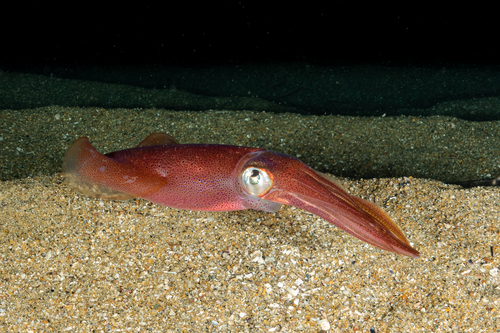
The European squid or common squid (Loligo vulgaris) is a large squid belonging to the family Loliginidae. It occurs abundantly in coastal waters from the North Sea to at least the west coast of Africa. This species lives from sea level to depths of 500 m (1,600 ft). Its mantle is up to 40 cm (16 in) long. The species is extensively exploited by commercial fisheries.

Loligo reynaudii, the Cape Hope squid, was previously treated as a subspecies of L. vulgaris.

Appearance

The European squid has a long, moderately slender and cylindrical body. Rhomboid fins comprise two-thirds of the mantle length, though locomotion is via jet propulsion. The posterior border is slightly concave. The head is relatively small and has large eyes which are covered with a transparent membrane. Like almost all squid, this species has ten limbs surrounding the mouth and beak: eight are relatively short arms, and two, which form the tentacles, are long, as they are used to catch prey. The fourth left arm of males is a hectocotylus. The European squid can grow up to 30–40 cm in the mantle length, but more usually they are 15–25 cm long. The males are generally bigger than the females and exhibit more rapid rates of growth.

Habitat

The European squid is a neritic, semidemersal species, which undertakes distinct horizontal and vertical migrations, depending on the environment. In the Adriatic Sea, European squid can be found above various substrates, from sandy through to the muddy bottoms. It is found in temperatures of 13°C–20°C, preferring 18°C.

L. vulgaris is found throughout the Mediterranean and in the eastern Atlantic Ocean from the North Sea to the Gulf of Guinea. In British waters, it is mainly found in the Irish Sea, along the south coast of England, and off northern Scotland.

Humans & conservation

The European squid is a commercially valuable species. It is caught in multispecies trawl fishing throughout the year and, seasonally, in small scale and recreational fishing with a variety of gear.

In the Adriatic Sea, the total annual catch of the species is around 1,000 to 1,500 tonnes. This is very variable and is probably linked to the annual reproduction cycle that is typical for many cephalopods.

Part of

Where to see it

No dive sites list European Squid yet. Explore the map to find sites near you.