
← All marine life
European Plaice
Species IUCN · Least Concern (LC)

European Plaice

Pleuronectes platessa, Linnaeus, 1758

marinebrackish

About European Plaice

The European plaice (Pleuronectes platessa), commonly referred to as simply plaice, or schol in Dutch, is a species of marine flatfish in the genus Pleuronectes of the family Pleuronectidae.

Appearance

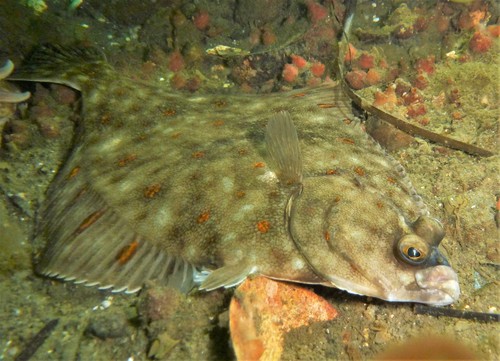
The European plaice is characterized, on their dorsal side, by their dark green to dark brown skin, blotched with conspicuous, but irregularly distributed, orange spots. The ventral side is pearly white. The skin is smooth with small scales. They are able to adapt their colour somewhat to match that of their surroundings, but the orange spots always remain visible. The skin lacks any prickles.

Habitat

European plaice is a common flatfish which inhabits sandy and muddy bottoms of the European shelf, usually at depths between 10 and 200 m. It is found from the Barents Sea down to the Iberian peninsula and around Iceland and the Faroe Islands. It is often reported in ichthyological check lists for the Mediterranean Sea but this is likely to be misidentified specimens of European flounder.

Adult fish are generally found in deeper waters whereas young fish are found in shallow waters e.g. estuaries and sandy coasts. Plaice tend to burrow in the sediment during the day and remain stationary for long periods to avoid predators and ambush prey.

Diet

It is active at night and feeds on polychaetes, crustaceans and bivalves. Young plaice (between 1 and 2 years old) tend to consume mainly shrimps.

Humans & conservation

European plaice are generally caught as part of a mixed flatfish fishery or in other groundfish fisheries. The most common gears used in these fisheries are beam trawls, otter trawls and Danish seine. It is also caught in other fishing gears such as bottom set gillnets, longlines and hand lines. The majority of landings of European plaice are caught in the North Sea. Total landings peaked in 1985–1990 when approximately 200 thousand tonnes were landed, current landings are generally less than 120 thousand tonnes.

After a period of time in the 1980s and 1990s where landings exceeded management advice for several stocks, the fishing pressure has been reduced and the status of the stocks has improved and all the stocks are considered to be within safe biological limits as defined by ICES.

Part of

Where to see it

No dive sites list European Plaice yet. Explore the map to find sites near you.