← All marine life
European Flounder
Species IUCN · Least Concern (LC)

European Flounder

Platichthys flesus, (Linnaeus, 1758)

marinebrackishfreshwater

About European Flounder

The European flounder (Platichthys flesus) is a flatfish of European coastal waters from the White Sea in the north to the Mediterranean and the Black Sea in the south. It has been introduced into the United States and Canada accidentally through transport in ballast water. It is caught and used for human consumption.

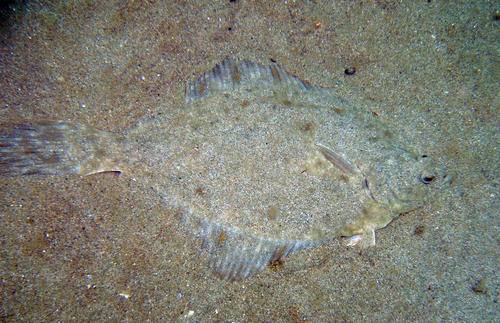
The European flounder is oval in shape and is usually right-eyed. It normally grows about 30 cm in length, although lengths of up to 60 cm have been recorded. The upper surface is usually dull brown or olive in colour with reddish spots and brown blotches and this fish can change colour to suit its background, providing an effective camouflage. The underside is pearly-white, giving the fish one of its common names, the white fluke. The lateral line features rows of small tubercles, as do the bases of the dorsal and anal fins.

Appearance

The European flounder is a flatfish with an oval-shaped body with a width about half its length. The maximum recorded length is 60 centimetres (24 in) and the maximum recorded weight 2.93 kilograms (6.5 lb). However, a more usual mature length is about 50 centimetres (20 in).

Habitat

The European flounder is native to the north eastern Atlantic Ocean and the Mediterranean Sea. The range extends from the Barents Sea, White Sea and Baltic Sea to Greece, Turkey, the Black Sea and the North African coast. It has been introduced into Iran and has become established off the eastern coast of Canada and the United States, possibly getting there by way of ballast water. It is normally found from the low shore down to depths of about 100 metres (330 ft) on sandy, shingle or muddy bottoms where its dappled colouring camouflage it and make it difficult to detect.

Humans & conservation

The European flounder is used for human consumption but is not so highly esteemed as the European plaice or common sole (Solea solea). The most important fisheries are in the Baltic Sea and the waters around the Netherlands and Denmark. In 2010, the total world catch was about nineteen thousand tonnes, mostly caught by bottom trawling. The fish is marketed fresh and frozen and can be fried, boiled, steamed, baked or microwaved.

It has been found that male European flounders living in polluted estuaries may show signs of excess exposure to oestrogens. Substances such as vitellogenins have been identified in their blood at between four and six times the concentration found in the blood of fish from uncontaminated areas; however, the flounder is less sensitive to oestrogens than is the freshwater rainbow trout.

Part of

Where to see it

No dive sites list European Flounder yet. Explore the map to find sites near you.