
← All marine life
European Anchovy
Species IUCN · Least Concern (LC)

European Anchovy

Engraulis encrasicolus, (Linnaeus, 1758)

marinebrackish

About European Anchovy

The European anchovy (Engraulis encrasicolus) is a forage fish somewhat related to the herring. It is a type of anchovy; anchovies are placed in the family Engraulidae. It lives off the coasts of Europe and Africa, including in the Mediterranean Sea, the Black Sea, and the Sea of Azov. It is fished by humans throughout much of its range.

Appearance

It is easily distinguished by its deeply cleft mouth, the angle of the gape being behind the eyes. The pointed snout extends beyond the lower jaw. The fish resembles a sprat in having a forked tail and a single dorsal fin, but the body is round and slender. The record weight for a single fish is 49 g (1.7 oz). The maximum recorded length is 21 cm (8+1⁄8 in). 13.5 cm (5.3 in) is a more typical length. It has a silver underbelly and blue, green or grey back and sides. A silver stripe along the side fades away with age.

Habitat

The European anchovy is a coastal pelagic species; in summer, it usually lives in water less than 50 m deep (although, in the Mediterranean, it goes to depths of 200 m in winter), and it may go as deep as 400 m. As it is euryhaline, it can live in water with a salinity of 5–41 PSU (sea water salinity is usually 35 PSU). It can therefore live in brackish water in lagoons, estuaries, and lakes.

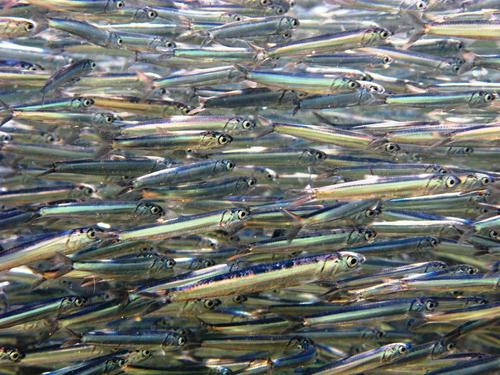
European anchovies eat plankton, mostly copepods and the eggs and larvae of fish, molluscs, and cirripedes. They are migratory, often travelling northwards in summer and south in winter. They form large schools, and may form bait balls when threatened (see image, below).

European anchovies are eaten by many species of fish, birds and marine mammals.

Reproduction

The species spawn multiply in warm periods from about April to November, depending on when the temperatures are warm enough. At least some local subpopulations have separate spawning grounds, and are thus genetically distinct, although spawning grounds shift. Some spawn in fresh water. The shape of the eggs is ellipsoidal to oval. The eggs float as plankton in the upper 50 m of the water column for about 24–65 hours before hatching. The hatched larvae are transparent and grow rapidly; a year later, in the unlikely event that they survive, they will be 9–10 cm (3.5–3.9 in) long. The females are larger than the males. When they reach a length of 12–13 cm (4.7–5.1 in), they spawn for the first time. A survey in southwestern Africa found no specimens older than three years.

Humans & conservation

The IUCN considers the fisheries to be abundant and fully exploited, and in need of careful monitoring. The highly international species has no concerted management plan.

Local populations fluctuate, and have shown large fluctuations in the past. These fluctuations are not well understood. Some past declines have been due to environmental problems, local overfishing, and invasive species from ballast water. Mnemiopsis leidyi is an invasive species which eats European anchovy eggs. Some past fluctuations are likely due to climate change.

European anchovies are caught with purse seines, lamparas, trawls and beach seines. Bycatch is thought, on the basis of insufficient data, to be minor.

Part of

Where to see it

No dive sites list European Anchovy yet. Explore the map to find sites near you.