
← All marine life
East Pacific Red Octopus
Species IUCN · Least Concern (LC)

East Pacific Red Octopus

Octopus rubescens, S. S. Berry, 1953

marine

About East Pacific Red Octopus

Octopus rubescens (commonly the East Pacific red octopus, also known as the ruby octopus, a preferred common due to the abundance of octopus species colloquially known as red octopus) is the most commonly occurring shallow-water octopus on much of the North American West Coast and a ubiquitous benthic predator in these habitats. Its range extends from the southern Gulf of California to at least the Gulf of Alaska, but may also occur in the western Pacific Ocean. O. rubescens occurs intertidally to a depth of 300 m (980 ft).

Appearance

O. rubescens generally grows to a mantle length of 8–10 cm (3.1–3.9 in), and arm length of 30–40 cm (12–16 in). Adult weight is generally 100–150 grams (3.5–5.3 oz), but animals up to 400 grams (14 oz) in weight have occasionally been observed.

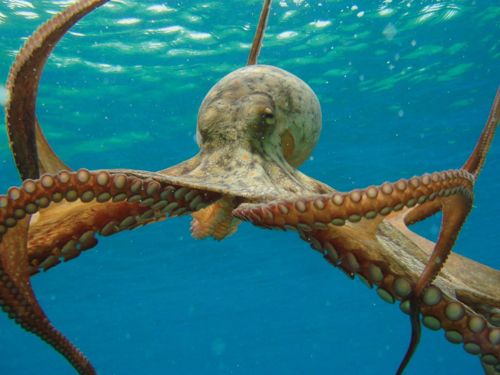
Like all octopuses, O. rubescens can change its color and texture, making its appearance highly variable. Color can vary from a deep brick red, to brown, to white, or mottled mixtures of the three. It can be easily confused with small individuals of Enteroctopus dofleini in the northern end of this species' range. The two can be differentiated by the presence of three eyelash-like papillae below the eyes of O. rubescens that are absent in E. dofleini.
Diet

O. rubescens is a generalist predator and has been maintained on a wide variety of gastropods, bivalves, crabs, and barnacles in the lab. So far, very little quantification of its diet in the wild has been made, two studies on the subject have determined that diets within Puget Sound, Washington are dominated by gastropods, particularly Nucella lamellosa and Callianax alectona, but also composed of clams, scallops, and crabs. The planktonic larvae of O. rubescens have also been observed in the wild to consume krill. Although the captive behavior of O. rubescens led many to believe they are nocturnal foragers, a study within Puget Sound, Washington found that a localized population was likely diurnal. Recent camera trap observations within Puget Sound may also point towards a non-aggressive interspecific relationships between O.

Behaviour

O. rubescens was the first invertebrate in which individual personalities were demonstrated.

Part of

Where to see it

No dive sites list East Pacific Red Octopus yet. Explore the map to find sites near you.