
← All marine life
East Asian Common Octopus
Species

East Asian Common Octopus

Octopus sinensis, A. d'Orbigny, 1834

marine

About East Asian Common Octopus

Octopus sinensis (commonly known as the East Asian common octopus) is a mollusk belonging to the class Cephalopoda. Octopus sinensis is a shallow-water species found in coastal temperate waters of Japan, South Korea, and China, with the species name, sinensis being Latin for "Chinese". Octopus sinensis is closely related to the Atlantic and Mediterranean common octopus, Octopus vulgaris, another octopus inhabiting the benthic zone; the two are so morphologically similar that O. sinensis was considered a population of Octopus vulgaris until 2017. Octopus sinensis are carnivores that prey upon on many shallow-water animals such as crustaceans and mollusks.

Appearance

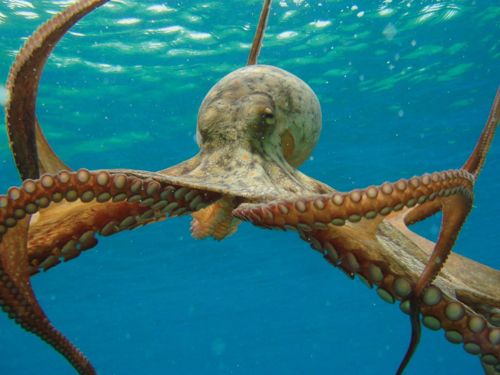
The East Asian common octopus is adapted to a benthic life at the bottom of the sea. Octopus sinensis has long arms with many suckers used for catching prey, a mantle without a rigid skeleton, which allows them to inhabit and hunt in small spaces and crevices in the seabed, horizontal pupils, and versatile skin with ability to change colors and camouflage themselves with the sea floor. Compared to O. vulgaris, O. sinensis have a broader mantle and relatively shorter arms with about 80 fewer suckers. Additionally, the third arm on the right of mature male O. sinensis have far fewer suckers than the same arm on O. vulgaris (120-140 vs. 150–190). This hectocotylized third right arm possesses erectile tissue on its tip and a channel for sperm packets. During copulation, O. sinensis males insert their third right arm into the female's mantle.
Humans & conservation

Both O. vulgaris and O. sinensis are commercially important food sources in China and both are vulnerable to over fishing. Therefore, it is important to delineate the two species for sustainable and fisheries management. In fact, some researchers claim that the misidentification of O. sinensis as O. vulgaris may be masking the decline of octopuses worldwide. catches of octopus have been steadily declining across the globe. Due to its rapid rate of growth and its high commercial value, O. sinensis is of particular interest in aquacultural cultivation. There have been several studies since the 1960s that have attempted to rear O. sinensis and O. vulgaris aquaculturally with little success. Current studies are focused on developing more accurate gene expression profiles to better understand the metabolic process and nutritional requirements of O.

Part of

Where to see it

No dive sites list East Asian Common Octopus yet. Explore the map to find sites near you.