
← All marine life
Dwarf Seahorse
Species IUCN · Least Concern (LC)

Dwarf Seahorse

Hippocampus zosterae, Jordan & Gilbert, 1882

marine

About Dwarf Seahorse

The dwarf seahorse (Hippocampus zosterae) is a species of seahorse found in the subtidal aquatic beds of the Bahamas and parts of the United States. It is threatened by habitat loss. According to Guinness World Records, it is the slowest-moving fish, with a top speed of about 5 feet (1.5 m) per hour.

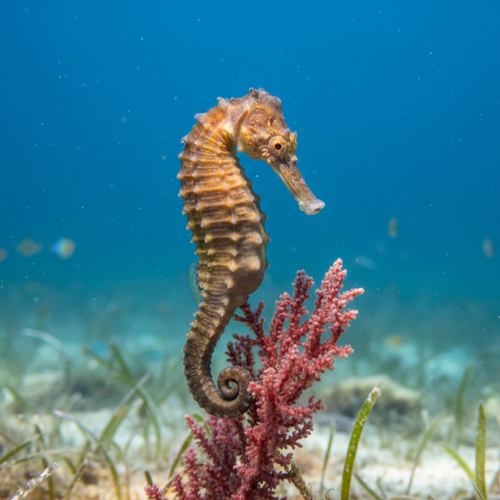
It is most often white in color but can range from tan, brown, yellow and green. In the wild, it often has small skin growths called cirri that resemble algae.

Appearance

Like other seahorses, the dwarf seahorse has a head angled at right angles to its body and swims upright using its dorsal fin to propel it and its pectoral fins to steer. It grows to an average length of 2 and 2.5 cm (0.8 and 1.0 in), with a maximum length of 5.0 cm (2.0 in).

The dwarf seahorse can live up to 2 years, but most commonly live around 1.

It can be found in colors of beige, yellow, green, and black and may have white speckles, dark spots or protrusions and is well-camouflaged, the coloring usually matching the gorgonian on which it is typically found. It can change color.

It has been observed that this seahorse changes color for various reasons such as camouflage, reaction to an attack, due to an illness, or during mating.
Habitat

H. zosterae are found on the western end of the Atlantic Ocean, precisely in the coastal Gulf of Mexico, Bahamas, Bermuda, the Florida Keys, Florida's east coast, Old Tampa Bay, Lemon Bay, Pensacola, and Texas.

They are restricted almost totally to seagrass microhabitats in shallow water, particularly in association with seagrasses of the genus Zostera. They are most common in bays during periods of high salinity, in coral reefs, floating vegetations, and between roots in mangrove swamps.

They often live as a pair, sometimes alone. Males are rather sedentary and live in a small home range of about 1 square metre (11 sq ft), whereas females roam on other males' territory, around a hundred times larger than theirs.

Diet

The dwarf seahorse is a lie-in-wait predator, feeding on living prey, including small crustaceans such as amphipods, small shrimps, other small invertebrates, and fish fry. Once their target is fixed, the hunter stretches towards it and sucks it through its snout. Food progresses through the digestive system rapidly, causing the nutrients to be ill-absorbed. This is the reason seahorses require large amounts of food to survive. These creatures can consume up to 3,000 brine-shrimps per day.

Reproduction

Although, as every other seahorse species, it is the male that carries the offspring, they must still compete to access a mate. Males will tail wrestle and snap their heads toward each other and make clicking sounds during competition for access to a female. They display an eloquent courtship dance that begins each morning until copulation takes place.

Humans & conservation

This species was particularly popular in the 1960s when mail order companies commonly sold them as the 'perfect pets'.

Due to its tiny size, the dwarf seahorse remains very popular in the aquarium market. Several Florida located fisheries' core business lay around dwarf seahorses capture and trade.

Chinese medicine is one of the biggest consumers of seahorses, as an estimated 20 million seahorses are used each year. They supposedly have cholesterol decrease virtues, preventing atherosclerosis.

Part of

Where to see it

No dive sites list Dwarf Seahorse yet. Explore the map to find sites near you.