
← All marine life
Dwarf Eelgrass
Species IUCN · Least Concern (LC)

Dwarf Eelgrass

Zostera noltii, Hornemann, 1832

marine

About Dwarf Eelgrass

Zostera noltii is a species of seagrass known by the common name dwarf eelgrass. It is found in shallow coastal waters in north western Europe, the Mediterranean Sea, Black Sea, Caspian Sea and Aral Sea and on islands in the Atlantic off the coast of northwest Africa. It is an important part of the intertidal and shallow subtidal ecosystems of estuaries, bays and lagoons.

Appearance

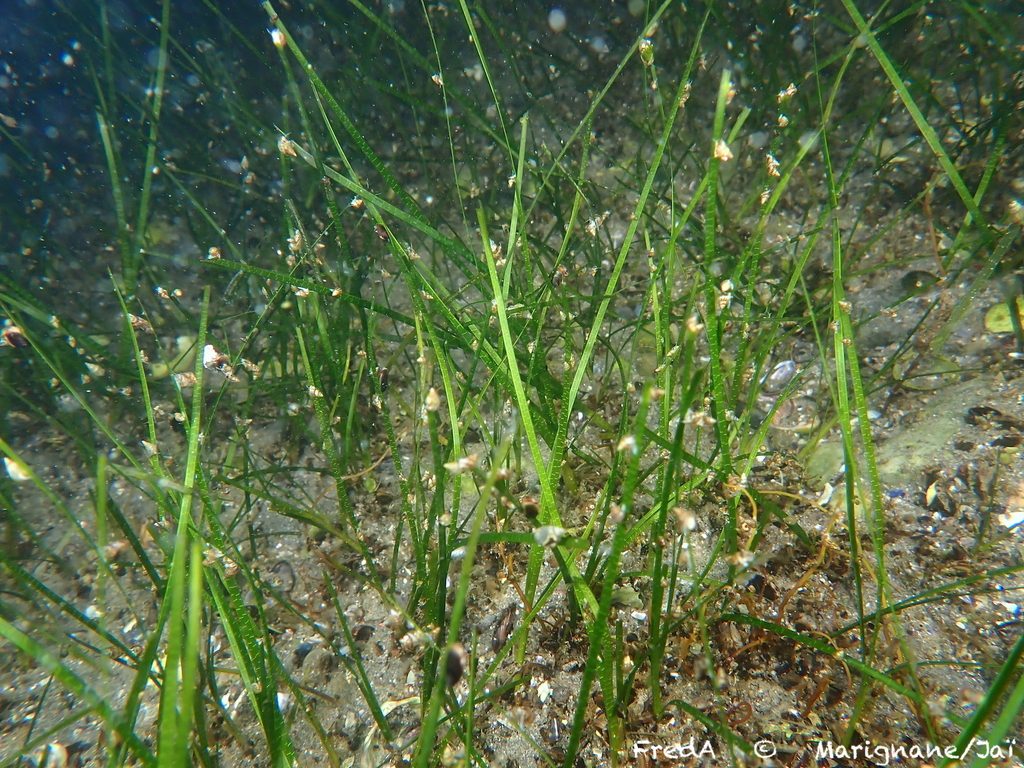
Zostera noltii has a creeping rhizome that runs along under the surface of the seabed. Groups of two to five strap-shaped leaves grow out of nodes on the rhizome and each node also bears a tuft of up to four short roots that anchor the plant in the sediment. The leaves have three irregular, longitudinal veins and blunt, notched ends. They are up to 22 cm (9 in) long and contain air spaces which make them buoyant. Several separate male and female flowers grow on a short, spear-shaped lateral stem. The smooth white seeds develop inside a green capsule with membranous walls and are about 2 mm (0.08 in) long.

Habitat

Zostera noltii is found in the eastern Atlantic Ocean along the coasts of Europe as far north as Norway, Sweden and the Baltic Sea. Around the British Isles it grows extensively in the Firths of Moray and Cromarty, the Wash and the Thames Estuary. In Ireland substantial quantities are found in Strangford Lough, Dungarvan Harbour and Dublin Bay. In the Mediterranean Sea and the Black Sea, it is restricted to the brackish conditions found in lagoons and estuaries. It is the only species of seagrass found in the Caspian Sea and the Aral Sea. It also grows in Morocco, Mauritania, and the Canary Islands, with the southernmost known population in the Saloum Delta in Senegal. It grows intertidally on fine sandy or muddy substrates and can tolerate various levels of salinity.

Behaviour

Seagrass beds are highly productive and form the basis of important coastal ecosystems. Many different species of algae grow epiphytically on Zostera noltii. These include the brown algae species Cladosiphon zosterae, Halothrix lumbricalis, Leblondiella densa, Myrionema magnusii and Punctaria crispata. These also grow on other seagrasses such as Zostera marina. A parasite, Plasmodiophora bicaudata, attacks eel grasses, including Zostera noltii. It prevents further growth between the nodes and damages clumps with the leaves growing in tufts, causing what is known as wasting disease. Eel grass beds provide a refuge for many invertebrates and a safe haven for developing juvenile fish. The detritus produced when the leaves decay in winter enriches the sediment.

Where to see it

No dive sites list Dwarf Eelgrass yet. Explore the map to find sites near you.