
← All marine life
Dusky Flathead
Species

Dusky Flathead

Platycephalus fuscus, Cuvier, 1829

marinebrackish

About Dusky Flathead

Platycephalus fuscus, the dusky flathead or black flathead, (literally translating from Ancient Greek as "flat-head dusky") is a large predatory fish and the largest member of the family Platycephalidae. Dusky flathead are a largely estuarine species and are found in estuaries, estuarine lakes and coastal bays on the east coast of Australia, from Cairns in Queensland to the Gippsland Lakes in Victoria. They occur over sand, mud, gravel and seagrass and can inhabit estuarine waters up to the tidal limit.

Appearance

Flathead are notable for their unusual body shape, upon which their hunting strategy is based.

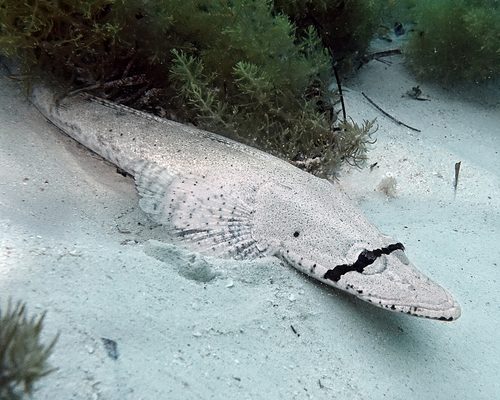
Flathead are dorsally compressed, meaning their body is wide but flattened and very low in height. Both eyes are on the top of the flattened head, giving excellent binocular vision in order to attack overhead prey. The effect is somewhat similar to flounder. In contrast to flounder however, flathead are much more elongated, the tail remains vertical, and the mouth is large, wide and symmetrical. Flathead use this body structure to hide in sand (their body colour changes to match their background), with only their eyes visible, and explode upwards and outwards to engulf small fish and prawns as they drift over the hidden flathead.
Behaviour

Dusky flathead are the largest of the many species of flathead found in Australia, and the most commonly caught. Dusky flathead have very rarely been caught at sizes up to 12–15 kg and lengths up to 1.3 metres, but average size is 0.5–1.5 kg and 40–50 cm. Typically a fish of estuaries and estuarine lakes, dusky flathead are rarely found in other habitats.

Part of

Where to see it

No dive sites list Dusky Flathead yet. Explore the map to find sites near you.