
← All marine life
Dugong
Species IUCN · Vulnerable (VU)

Dugong

Dugong dugon, (Müller, 1776) Palmer, 1895

marine

About Dugong

The dugong (; Dugong dugon) is a marine mammal. It is one of four living species of the order Sirenia, which also includes three species of manatees. It is the only living representative of the once-diverse family Dugongidae; its closest modern relative, Steller's sea cow (Hydrodamalis gigas), was hunted to extinction in the 18th century.

The dugong is the only sirenian in its range, which spans the waters of some 40 countries and territories throughout the Indo-West Pacific. The dugong is largely dependent on seagrass communities for subsistence and is thus restricted to the coastal habitats that support seagrass meadows, with the largest dugong concentrations typically occurring in wide, shallow, protected areas, such as bays, mangrove channels, the waters of large inshore islands, and inter-reefal waters. The northern waters of Australia between Shark Bay and Moreton Bay are believed to be the dugong's contemporary stronghold.

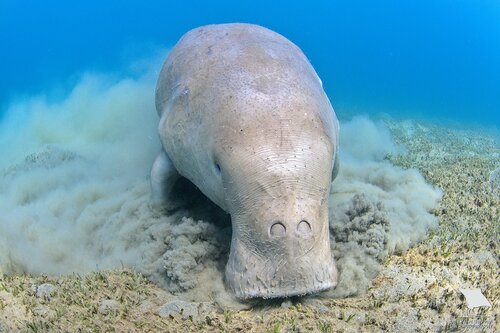
Like all modern sirenians, the dugong has a fusiform body with no dorsal fin or hind limbs. The forelimbs or flippers are paddle-like. The dugong is easily distinguishable from the manatees by its fluked, dolphin-like tail; it also possesses a unique skull and teeth. Its snout is sharply downturned, an adaptation for feeding in benthic seagrass communities. The molar teeth are simple and peg-like, unlike the more elaborate molar dentition of manatees.

Appearance

The dugong's body is large with a cylindrical shape that tapers at both ends. It has thick, smooth skin that is a pale cream colour at birth but darkens dorsally and laterally to brownish-to-dark-grey with age. The colour of a dugong can change due to the growth of algae on the skin.

An adult's length rarely exceeds 3 metres (10 ft). An individual this long is expected to weigh around 420 kilograms (930 lb). Weight in adults is typically more than 250 kilograms (550 lb) and less than 900 kilograms (1,980 lb). The largest individual recorded was 4.06 metres (13 ft 4 in) long and weighed 1,016 kilograms (2,240 lb), and was found off the Saurashtra coast of west India. Females tend to be larger than males.
Habitat

Dugongs are found in warm coastal waters from the western Pacific Ocean to the eastern coast of Africa, along an estimated 140,000 kilometres (87,000 mi) of coastline between 26° and 27° to the north and south of the equator. Their historic range is believed to correspond to that of seagrasses from the Potamogetonaceae and Hydrocharitaceae families. The full size of the former range is unknown, although it is believed that the current populations represent the historical limits of the range, which is highly fractured. Their distributions during warmer periods of the Holocene might have been broader than today. Today, populations of dugongs are found in the waters of 37 countries and territories. Recorded numbers of dugongs are generally believed to be lower than actual numbers, due to a lack of accurate surveys.

Diet

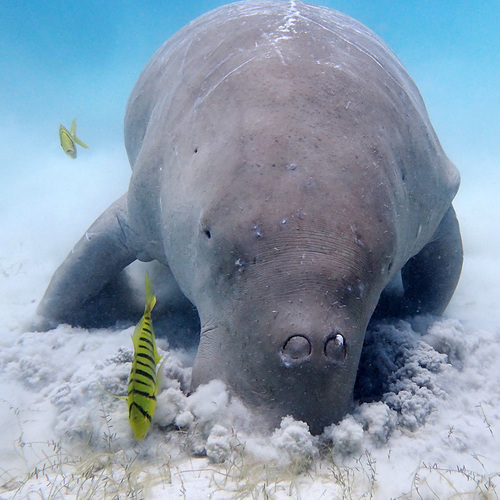
Dugongs, along with other sirenians, are referred to as "sea cows" because their diet consists mainly of seagrass, particularly the genera Halophila and Halodule. When eating they ingest the whole plant, including the roots, although when this is impossible they will feed on just the leaves. A wide variety of seagrass has been found in dugong stomach contents, and evidence exists they will eat algae when seagrass is scarce. Although almost completely herbivorous, they will occasionally eat invertebrates, such as jellyfish, sea squirts, and shellfish. Dugongs in Moreton Bay, Australia, are omnivorous, feeding on invertebrates such as polychaetes or marine algae when the supply of their choice grasses decreases. In other southern areas of both western and eastern Australia, there is evidence that dugongs actively seek out large invertebrates.

Behaviour

Dugongs are long-lived, and the oldest recorded specimen reached age 73. They have few natural predators, although animals such as crocodiles, killer whales, and sharks pose a threat to the young, and a dugong has also been recorded to have died from trauma after being impaled by a stingray barb. A large number of infections and parasitic diseases affect dugongs. Detected pathogens include helminths, cryptosporidium, different types of bacterial infections, and other unidentified parasites. 30% of dugong deaths in Queensland since 1996 are thought to be because of disease.

Reproduction

A dugong reaches sexual maturity between the ages of eight and eighteen, older than in most other mammals. Females know that a male has reached sexual maturity by the eruption of the male's tusks, since tusks erupt in males when testosterone levels reach a high enough level. The age when a female first gives birth is disputed, with some studies placing the age between ten and seventeen years while others place it as early as six years. There is evidence that male dugongs lose fertility at older ages.

Despite the longevity of the dugong, which may live for 50 years or more, females give birth only a few times during their lives and invest considerable parental care in their young. The time between births is unclear, with estimates ranging from 2.4 to 7 years.

Humans & conservation

Dugongs have historically provided easy targets for hunters, who killed them for their meat, oil, skin, and bones. As the anthropologist A. Asbjørn Jøn has noted, they are often considered the inspiration for mermaids, and people around the world developed cultures around dugong hunting. In some areas, it remains an animal of great significance, and a growing ecotourism industry around dugongs has had an economic benefit in some countries.

There is a 5,000-year-old wall painting of a dugong, apparently drawn by Neolithic peoples, in Tambun Cave, Ipoh, Malaysia. This was discovered by Lieutenant R.L. Rawlings in 1959 while on a routine patrol.

Part of

Where to see it

No dive sites list Dugong yet. Explore the map to find sites near you.