
← All marine life
Double-Lined Fusilier
Species IUCN · Least Concern (LC)

Double-Lined Fusilier

Pterocaesio digramma, (Bleeker, 1864)

marine

About Double-Lined Fusilier

The double-lined fusilier (Pterocaesio digramma), also known as the double stripe fusilier or blacktipped fusilier, is a species of marine ray-finned fish, a fusilier belonging to the family Caesionidae. It is widespread around reefs in the Indo-West Pacific region.

Appearance

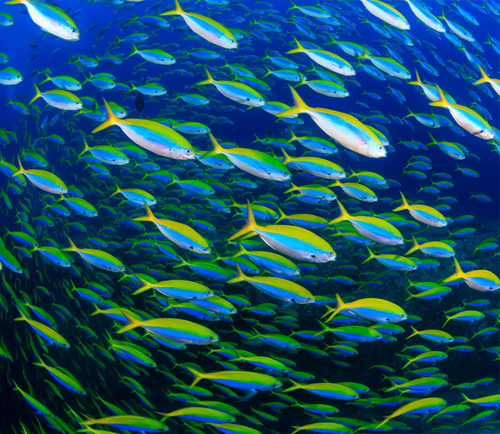
The double-lined fusilier has a fusiform and elongated body which is moderately laterally compressed. There are small conical teeth in the jaws and on the vomer and palatines. The dorsal fin contains 10 spines and 14–16 soft rays while the anal fin has three spines and 11–12 soft rays. There are scales on both the dorsal and anal fins. There are 20–22 rays in the pectoral fins. This species attains a maximum total length of 30 cm (12 in). The overall colour is bluish-green lightening towards the lower body. There are a pair of slender yellow stripes along the back and middle of the flank. The caudal fin lobes have dark tips. The more ventral yellow stripe is mainly underneath the lateral line, apart from the portion on the caudal peduncle.
Habitat

The double-lined fusilier is found in the Western Pacific Ocean where it occurs from Indonesia, Western Australia and New Caledonia to southern Japan. It has also been recorded off Norfolk Island and in Tonga. The record from Réunion is probably a mis-identified Pterocaesio marri. It occurs in coastal waters at depths down to 50 m (160 ft), mainly around coral reefs.

Humans & conservation

The double-lined fusilier is subjected to heavy fishing pressure in many parts of its range. They are caught using drive-in nets, gill nets and fish traps, as well as by illegal blast fishing. It can be an important food fish, being popular in the Philippines. The landings are sold fresh or preserved as salt fish.

Part of

Where to see it

No dive sites list Double-Lined Fusilier yet. Explore the map to find sites near you.