
← All marine life
Devil Scorpionfish
Species IUCN · Least Concern (LC)

Devil Scorpionfish

Scorpaenopsis diabolus, (Cuvier, 1829)

marine

About Devil Scorpionfish

Scorpaenopsis diabolus, the false stonefish, false scorpionfish or the devil scorpionfish, is a species of venomous marine ray-finned fish belonging to the family Scorpaenidae, the scorpionfishes. It has venomous spines and lives in the tropical Indian and Pacific Oceans as well as in the Red Sea. It is a bottom-dwelling predator that relies on its camouflage to catch passing prey.

Appearance

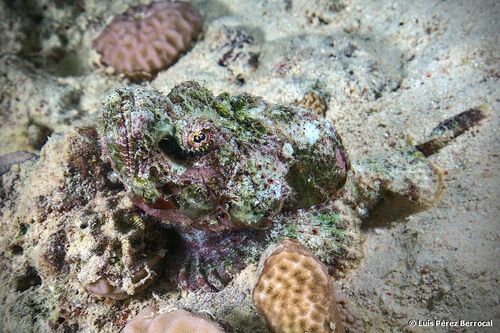
Scorpaenopsis diabolus has a broad head with a wide mouth, a humped back, and a tapering body, and can reach 30 cm (12 in) in length. Its dorsal fin has 12 venomous spines and eight to 10 soft rays. The anal fin has three spines and five to six soft rays. The skin is rough with low conical projections, spines, and tassels. The colouring is a combination of mottled grey and white with reddish-brown blotches and the fish is well-camouflaged among stones and corals. The inner sides of the broad pectoral fins have orange, black, and white blotches and the fins can be "flashed" as a warning. This fish closely resembles the reef stonefish (Synanceia verrucosa).

Habitat

Scorpaenopsis diabolus is found at depths to about 70 m (230 ft) in the Indian and Pacific Oceans. Its range extends from South and East Africa and the Red Sea to Japan, Hawaii, French Polynesia, Australia, and New Caledonia. It is found on the seabed among rubble, seaweed-covered rocks or on rocks encrusted with coralline algae on reef flats, lagoons, and the seaward side of reefs.

Part of

Where to see it

No dive sites list Devil Scorpionfish yet. Explore the map to find sites near you.