
← All marine life
Dark Shyshark
Species IUCN · Least Concern (LC)

Dark Shyshark

Haploblepharus pictus, (Müller & Henle, 1838)

marine

About Dark Shyshark

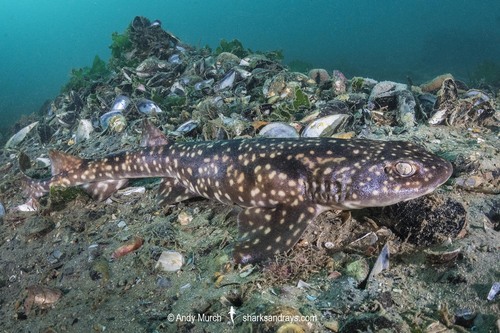
The dark shyshark or pretty happy (Haploblepharus pictus) is a species of shark belonging to the family Pentanchidae, the deepwater catsharks. This species is endemic to the temperate waters off southern Namibia and western South Africa. It is benthic in nature and inhabits shallow, inshore waters and favors rocky reefs and kelp forests. Growing to 60 cm (24 in) long, this small, stocky shark has a wide, flattened head with a rounded snout and a large flap of skin extending from before the nostrils to the mouth. Its dorsal coloration is extremely variable and may feature black-edged orange to blackish saddles and/or white spots on a light brown to nearly black background.

When threatened, the dark shyshark curls into a ring with its tail covering its eyes, hence the name "shyshark". It preys mainly on small crustaceans, bony fishes, and molluscs. Reproduction is oviparous and proceeds throughout the year. Females lay two egg cases at a time, which hatch after 6–10 months. This harmless species is of little commercial significance due to its small size. It is frequently caught by recreational fishers and persecuted as a pest. The International Union for Conservation of Nature (IUCN) has listed the dark shyshark under Least Concern, as it is common and does not appear to be substantially threatened by fishing or habitat degradation.

Appearance

Reaching no more than 60 cm (24 in) long, the dark shyshark differs from other shysharks in that it is slender-bodied when juvenile and stocky-bodied when adult. Its head is short, wide, and flattened, with a bluntly rounded snout and very large nostrils. The anterior rims of the nostrils bear greatly enlarged lobes of skin, which are fused into a single flap that reaches the mouth; the flap conceals the nasal excurrent openings and a pair of grooves that run between them and the mouth. The large, horizontally oval eyes are equipped with rudimentary nictitating membranes (protective third eyelids), and have strong ridges beneath. The mouth is short but wide and bears furrows at the corners extending onto both jaws. There are 45–83 upper and 47–75 lower tooth rows; each tooth has a long central cusp flanked by a pair of smaller cusplets.
Habitat

The range of the dark shyshark is restricted to the coastal waters of southern Africa, from north of Lüderitz in southern Namibia to east of the Storms River mouth in the Eastern Cape Province of South Africa. It is abundant, particularly west of Cape Agulhas. This species is a bottom-dweller found close inshore, from the intertidal zone to a depth of 35 m (115 ft). It prefers rocky reefs and kelp forests, but also presumably traverses sandy flats in between patches of more suitable habitat. As this shark is not known to travel long distances, there is likely subpopulation differentiation across parts of its range.

Behaviour

The dark shyshark is a generalist predator whose main food sources are, in descending order of importance, small benthic crustaceans, bony fishes, and molluscs. Larger sharks consume proportionately more crustaceans. Polychaete worms and echinoderms are also taken on occasion, and algae may be swallowed incidentally. This species is preyed upon by the broadnose sevengill shark (Notorynchus cepedianus), and potentially also other large fishes and marine mammals. When threatened, it adopts a characteristic defense posture in which it curls into a ring with its tail over its eyes; this behavior likely makes the shark harder to swallow and is the origin of the common names "shyshark" and "doughnut". In captivity, the whelks Burnupena papyracea and B. lagenaria have been documented piercing the egg cases of this species and extracting the yolk.

Humans & conservation

The dark shyshark poses no danger to humans and is too small to be of commercial importance. Many are hooked by sport fishers casting from the shore, who regard the shark as a pest and often kill it. It may also be caught by subsistence fishers and in lobster traps and bottom trawls, though not in substantial quantities. This shark occasionally finds its way into the aquarium trade, though there is no direct fishing for this purpose. As the dark shyshark remains common and does not seem heavily threatened by human activity, it has been assessed as Least Concern by the International Union for Conservation of Nature (IUCN). Its small range does raise concerns that an increase in regional fishing pressure or habitat degradation could impact the entire population.

Part of

Where to see it

No dive sites list Dark Shyshark yet. Explore the map to find sites near you.