
← All marine life
Cuckoo Wrasse
Species IUCN · Least Concern (LC)

Cuckoo Wrasse

Labrus mixtus, Linnaeus, 1758

marine

About Cuckoo Wrasse

The cuckoo wrasse (Labrus mixtus) is a species of wrasse native to the eastern Atlantic Ocean from Norway to Senegal, including the Azores and Madeira. It is also found in the Mediterranean Sea. They occur in weedy, rocky areas mostly between 40 and 80 m (130 and 260 ft). This species is an occasional food fish for local populations but is also popular as a game fish. It is also a popular fish for display in public aquaria.

Appearance

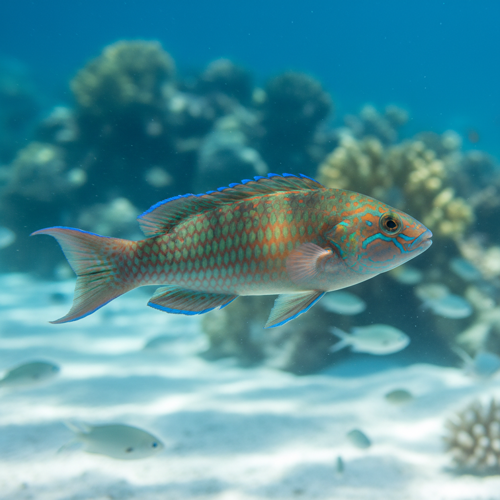
The cuckoo wrasse has a long, pointed head, its body is slimmer and more elongated in shape than the ballan wrasse (Labrus bergylta), with which it is sympatric in the north eastern Atlantic. It is a very colourful fish which shows clear sexual dimorphism. The young males and the females are coloured with a mix of pink, orange and red. The females possess three black spots on their back to the rear of the dorsal fin, with white colouration between then which stretch to the tail which are not present on males. The males have blue heads and orange bodies, blue stripes and mottled patterns run along the body and there are blue lines on the margins of the fins. Like the ballan wrasse, the cuckoo wrasse has a small mouth with thick fleshy, folded lips and a single row of canine-like teeth in each jaw.
Habitat

The cuckoo wrasse occurs in the north east Atlantic Ocean along the coast of Europe from Norway south to Andalusia and along the Atlantic coast of north Africa south to Senegal. It occurs off the Canary Islands, the Azores and Madeira too. Its range extends into the Mediterranean Sea as far as Cyprus, where it is common, but it is absent from the Levantine Sea.

Humans & conservation

The cuckoo wrasse is occasionally eaten, but wrasse flesh is not popular in many places, for example in Britain, so it is not much in demand from commercial fisheries. It is fished by recreational anglers. As they are long-lived fish, their populations can be affected by too high a catch, so they are fished on a catch and release basis.

In Norway, cuckoo wrasse (along with other wrasse species) are used in salmon farming to eat salmon lice from the farmed fish. This leads to overfishing in some areas, and a noticeable decrease in population in selected areas.

Part of

Where to see it

No dive sites list Cuckoo Wrasse yet. Explore the map to find sites near you.