
← All marine life
Crocodile Needlefish
Species IUCN · Least Concern (LC)

Crocodile Needlefish

Tylosurus crocodilus, (Péron & Lesueur, 1821)

marine

About Crocodile Needlefish

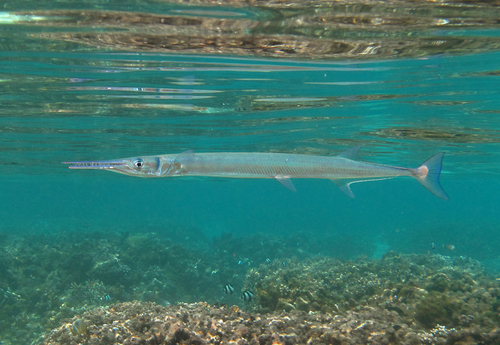
The houndfish, or more specifically the crocodile needlefish (Tylosurus crocodilus) is a game fish of the family Belonidae, the needlefishes. It is the largest member of its family, growing up to 5 feet (1.5 m) in length and 10 pounds (4.5 kg) in weight.

Appearance

A key way of distinguishing the houndfish from other members of the genus Tylosurus is that the houndfish's teeth point anteriorly when the fish is a juvenile. The teeth of other species are straight at all ages. The houndfish also has a more stout, cylindrical body and a shorter head than other needlefishes. Juvenile houndfish possess an elevated, black lobe on the posterior of their dorsal fins.

While the houndfish has no fin spines, its dorsal fin has 21–25 soft rays, and its anal fin has 19–22. They are also known to have 80–86 vertebrae. They have dark blue backs and silver-white sides and are plain white ventrally. A houndfish has a distinct keel on the caudal peduncle, and the caudal fin itself is deeply forked.

The longest recorded houndfish was 150 centimetres (4.9 ft), and the largest recorded weight was 6.35 kilograms (14.0 lb).
Habitat

Houndfish are found throughout the Indian and Pacific Oceans, their range stretching from the Red Sea and the coast of South Africa, east to French Polynesia, towards Japan, and south to New South Wales, Australia. The houndfish is replaced by its congener the Mexican needlefish in the eastern Pacific. Houndfish are known from New Jersey to Brazil in the west Atlantic, and in the east, they are found from Fernando Poo, Cameroon, and Liberia to Ascension Island. Houndfish can also be found near Guinea, Senegal and Cape Verde. It has been recorded in the eastern Mediterranean Sea, having moved from the Red Sea via the Suez Canal as part of the Lessepsian migration.

Humans & conservation

Houndfish are considered to be gamefish, and can be caught by use of artificial lights in a similar manner to other needlefishes. Although houndfish are considered good to eat and usually sold fresh, the market for them is small because their flesh has a greenish colour similar to that of the flat needlefish. The IGFA world record stands at 4.88 kg (10 lbs 12 oz) and was caught off Goulding Cay, Bahamas in 2013 by angler Daniel John Leonard using a live pilchard as bait.

Part of

Where to see it

No dive sites list Crocodile Needlefish yet. Explore the map to find sites near you.