
← All marine life
Common Seahorse
Species IUCN · Vulnerable (VU)

Common Seahorse

Hippocampus kuda, Bleeker, 1852

marinebrackish

About Common Seahorse

Hippocampus kuda is a species of seahorse, also known as the common seahorse, estuary seahorse, yellow seahorse or spotted seahorse. The common name sea pony has been used for populations formerly treated as the separate species Hippocampus fuscus, now a synonym of H. kuda.

Appearance

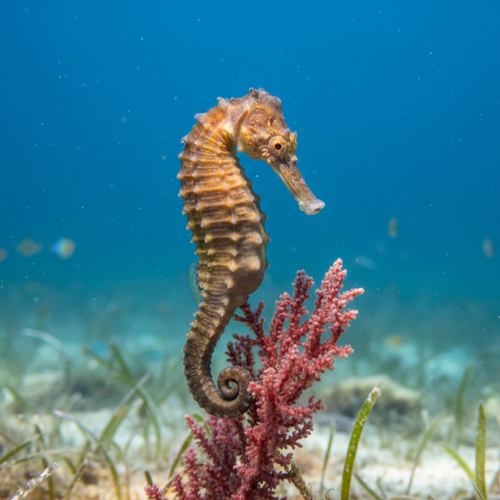
The yellow seahorse is a small fish that can reach a length of 17–30 cm (6.7–11.8 in). The body is quite large, elongated, and has no spines, all bumps are rounded. The head is relatively large compared to the body. The snout is short and thick. The coronet is small and rises towards the rear, it can also sometimes have more or less long filaments. Some adults have a black line running through the dorsal fin in the direction of its width. The body coloration is often dark with a grainy texture but can also be yellow, cream, or reddish blotches and numerous small dark spots.
Habitat

Hippocampus kuda inhabits waters from the Persian Gulf to Southeast Asia, Australia, Japan, and several Pacific islands including Hawaii, and is also found the eastern coast of Africa from Tanzania to South Africa, including the Indo-Pacific region ranging from the northwest Indian Ocean to the central areas of the Pacific Ocean. The majority of H. kuda populates the Chinese coast down to Australia.

H. kuda inhabit estuaries, lagoons, harbors, littoral zones, and coastal seagrass beds, where they are found in shallow waters of up to fifty-five meters in depth. Their habitat regions can include (but are not limited to) tropical, saltwater, or marine regions.

Diet

H. kuda are omnivores, feeding on minuscule living prey, such as larval fishes and zooplankton, via suction feeding. They are not strong swimmers. Predators of H. kuda include crabs, rays, tuna, and sea turtles, as well as humans.

Reproduction

The mating system of H. kuda is completely monogamous. The species engages in a unique courtship ritual before engaging in mating. The male will change its color patterns and dance around the female and while producing a clicking with the coronet. Eventually, the tails of the male and female intertwine and the female will place her eggs into the male's ventral brood pouch via an ovipositor. There may be up to one-thousand eggs in a singular pouch, where the developmental process can last from twenty to twenty-eight days. Birth, however, depends largely on the monsoon patterns, lunar cycles, and water temperature. Males typically go into labor during a full moon, and after birth, the baby seahorses average a length of seven millimeters.

Humans & conservation

H. kuda are extremely valuable to the traditional Chinese medicine trade. H. kuda has been said to regulate nervous, reproductive, endocrine, and immune systems. 25 million seahorses are used every year for medicinal purposes. The largest known exporters of H. kuda are Vietnam, India, the Philippines, and Thailand.

Part of

Where to see it

No dive sites list Common Seahorse yet. Explore the map to find sites near you.