
← All marine life
Common Roach
Species IUCN · Least Concern (LC)

Common Roach

Rutilus rutilus, (Linnaeus, 1758)

brackishfreshwater

About Common Roach

The roach, or rutilus roach (Rutilus rutilus), also known as the common roach, is a fresh- and brackish-water fish of the family Cyprinidae, native to most of Europe and western Asia. Fish called roach can be any species of the genera Rutilus, Leucos and Hesperoleucus, depending on locality. The plural of the term is also roach.

Appearance

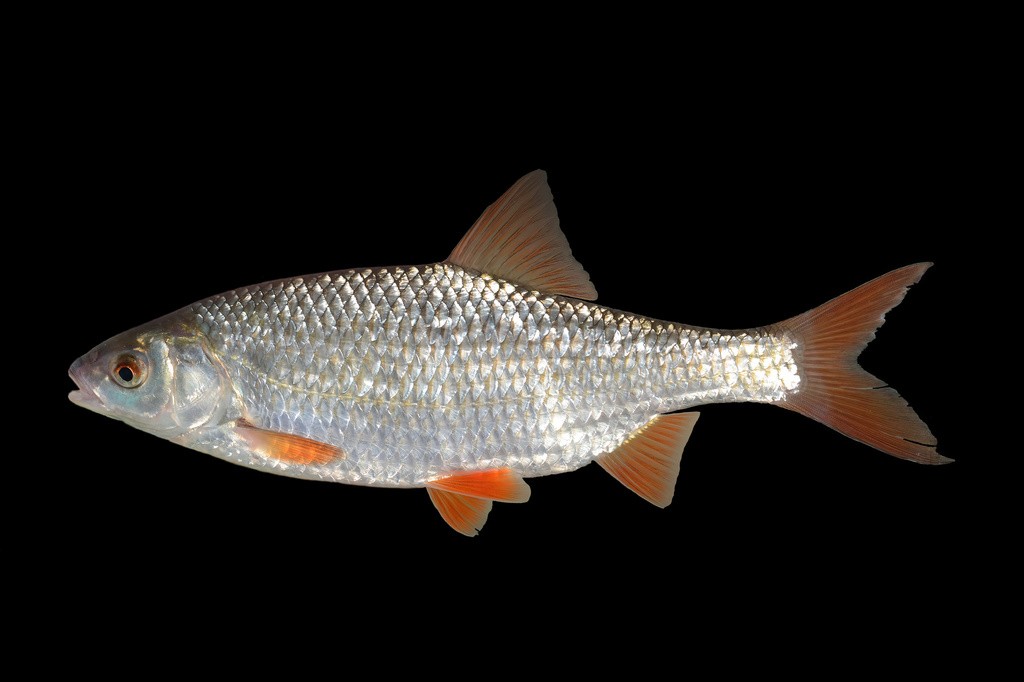
The roach is a small fish, often reaching no more than about 35 centimetres (14 in); maximum length is 50 cm (20 in). Its body has a bluish-silvery colour and becomes white at the belly. The fins are red. The number of scales along the lateral line is 39–48. The dorsal and anal fins have 12–14 rays. Young specimens have a slender build; older specimens acquire a higher and broader body shape. The roach can often be recognized by the big red spot in the iris above and beside the pupil. Colours of the eye and fins can be very pale, however, in some environments.

In Central and Northern Europe, the common roach can most easily be confused with the common rudd (Scardinius erythropthalmus), the dace (Leuciscus leuciscus), or the ide (Leuciscus idus). They can be distinguished by these characteristics:

Habitat

The common roach is found throughout Europe except for the area around the Mediterranean, and its distribution reaches eastward into Siberia. Eastern Europe and Asia have several subspecies, some with an oceangoing life cycle living around the Caspian and Black Seas. Around the Mediterranean and in northwestern parts of Spain and Portugal, several closely related species occur with no overlap in their distribution.

It was introduced in Australia in the Murray River and coastal drainages of southern New South Wales and Victoria from Europe during the 1860s and 1880s for sport purposes.

Behaviour

The common roach is very adaptable and can be found in any freshwater ecosystem, ranging from small ponds to the largest rivers and lakes. It feeds at any depth, although its preferred food sources tend to be in shallower water. It tolerates organic pollution and is one of the last species to disappear in polluted waters; it is also often the most numerous cyprinid in nutrient-poor waters. It also tolerates brackish water. Roach survive in temperatures from close to freezing 4 °C (39 °F) up to around 31 °C (88 °F).

Reproduction

The spawning season is generally from March to June, with some variation due to spawning being triggered by the rising of water temperature during spring and summer. Roach generally spawn at the same location each year. Large males form leks, which females enter. Males trail the females and fertilize their eggs. Their behaviour is rough and the fish often jump out of the water. A female can lay up to 100,000 eggs. When the pH of the water is below 5.5, the roach cannot reproduce successfully.

Where to see it

No dive sites list Common Roach yet. Explore the map to find sites near you.