
← All marine life
Common Galaxias
Species IUCN · Least Concern (LC)

Common Galaxias

Galaxias maculatus, (Jenyns, 1842)

marinebrackishfreshwater

About Common Galaxias

The common galaxias (Galaxias maculatus) or inanga (from the Māori īnanga or īnaka) is a species of ray-finned fish from the family Galaxiidae that is widespread in the Southern Hemisphere. It is migratory, living in fresh water but spawning at river mouths, spending the first six months of its life at sea, and returning en masse in spring. Its vernacular names include cowfish, jollytail, common jollytail, eel gudgeon, inaka, native trout, pulangi, puye, slippery tarki, spotted minnow, Falklands minnow and whitebait.

Appearance

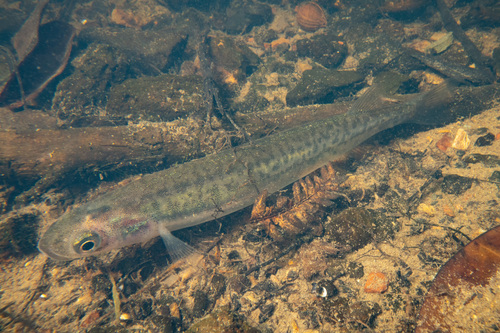
Common galaxias is a slim, narrow fish with a mottled, spotty pattern, iridescent silver eyes, undersides and gill covers, and some individuals have an iridescent green stripe along the top of their bodies which can be intermittently seen as they swim. Their specific name maculatus ("spotted") comes from the pattern of dark-mottled, leopard-like spots on an olive-brown background along their upper bodies. This pattern ranges from very subtle to quite bold. Common galaxias have slightly forked tails, unlike other most other galaxiids, which have square tails. Fully grown adults typically range from 8 to 11 cm (3.1 to 4.3 in) in length, with an average of 10 cm (4 in). The maximum reported length is 19 cm (7.5 in).

Habitat

Common galaxias are one of the most widely distributed freshwater fish in the world. They inhabit Chile (35–55°S), Patagonia, Argentina, the Falkland Islands, some Pacific Islands such as New Caledonia, New Zealand, coastal streams in south-eastern Australia, Tasmania, and southwest Western Australia and numerous waterfilled cenotes and caves in south-eastern South Australia.

Behaviour

This species is usually considered amphidromous, a particular type of diadromy meaning that reproduction occurs in fresh water and larval growth occurs in the sea.

Reproduction

Adult fish typically reach sexual maturity at one year and spawning is triggered by changes in day length and temperature. Unless landlocked within a lake, the common galaxias spawns mainly in autumn during spring tides in the tidally influenced reaches of rivers and streams but spawning in winter and spring has occurred. The eggs are laid en masse amongst flooded riparian vegetation by females. Male fish then release sperm into the water and the eggs are fertilised externally.

This type of spawning is called polygynandry. Eggs remain attached to the vegetation as the tide recedes. Two types of reproductive strategy occur: the most common is a 'boom bust' strategy whereby spawning occurs in one event and is followed by death (semelparity), or much more rarely spawning occurs in multiple years before death iteroparity.

Humans & conservation

Galaxiid species are, in general, threatened by human activities such as intensive agriculture and land change use. These activities have removed vegetation from stream banks that are needed for spawning to protect eggs from the sun. The increased nutrient input into streams from farming can lead to eutrophication. In New Zealand, their conservation status is declining, mostly because of habitat loss and degradation.

As adults, common galaxias eat insects, crustaceans, and molluscs. This is the same diet as introduced trout, which not only compete for food, but also readily eat them. In areas where trout have become naturalised, common galaxias are scarce. Common galaxias, therefore, are mostly found in stretches of streams and rivers that are less suitable for introduced trout.

Where to see it

No dive sites list Common Galaxias yet. Explore the map to find sites near you.