
← All marine life
Common Dentex
Species IUCN · Vulnerable (VU)

Common Dentex

Dentex dentex, (Linnaeus, 1758)

marine

About Common Dentex

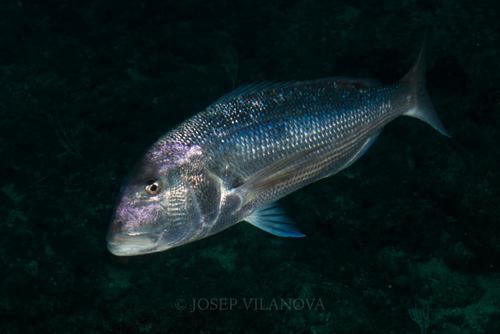
The common dentex (Dentex dentex) is a species of marine ray-finned fish belonging to the family Sparidae, which includes the seabreams and porgies. This species is found in the northeastern Atlantic Ocean and the Mediterranean Sea. It is a highly valued food fish and is an important target species for fisheries and the population has shown large declines leading the International Union for Conservation of Nature to classify its conservation status as Vulnerable.

Appearance

The common dentex has the dorsal fin supported by 11 spines, the spines increase in length from the first to the fourth or fifth and then are roughly equal in length from spine 6 to 12, and 11 or 12 soft rays while the anal fin has 3 spines and between 7 and 9 soft rays supporting it. The body is oval shaped and compressed. The dorsal profile of the head is smoothly rounded in adults but nearly straight in juveniles and is slightly convex in the largest specimens. The eyes are small and the space below them is wide. The cheeks are scaled as is the preoperculum except for its rear edge. The mouth is positioned low on the head and is slightly upward pointing. There are a number of rows of teeth, all are canine-like, with the most well-developed being in the front of the jaws.

Habitat

The common dentex is found in the northeastern Atlantic Ocean between the Bay of Biscay and Ras Nouadhibouin Mauritania, as well as the Canaries and Madeira. It is rare as far north as the British Isles. It is also found throughout the Mediterranean Sea and into the western Black Sea. This is a benthopelagic fish found at depths down to 200 m (660 ft), although commonest at 15 to 50 m (49 to 164 ft), over rocky substrates in inshore waters.

Humans & conservation

The common dentex is a highly valued food fish with a high commercial value and it has a life history which makes it vulnerable to overfishing, i.e. it is long-lived, slow-growing and is large bodied. In the Mediterranean its abundance increases within marine protected areas but it is scarce outside of these areas. Landings of common dentex increased drastically in the 1970s and 1980s before falling by 30% in the 1990s. The catches in the Mediterranean and West Africa decreased by 37% and 70%, respectively. Overall the total population for this species has been estimated to have declined by over 30% over the three generations (equivalent to 36 years) up to 2009 and the IUCN classifies this species as Vulnerable. This species is caught using bottom trawls, lines, fish traps and sometimes trammel nets. It is a popular sport fish for recreational anglers too.

Part of

Where to see it

No dive sites list Common Dentex yet. Explore the map to find sites near you.