
← All marine life
Common Cockle
Species

Common Cockle

Cerastoderma edule, (Linnaeus, 1758)

marine

About Common Cockle

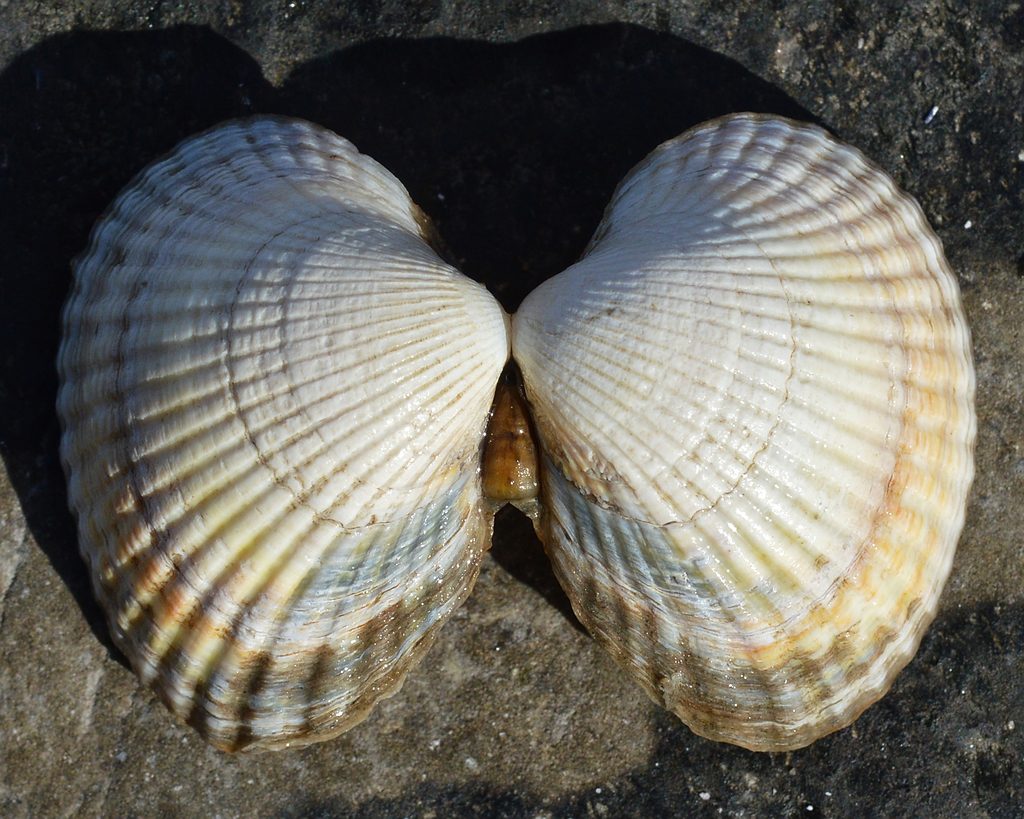
The common cockle (Cerastoderma edule) is a species of edible saltwater clam, a marine bivalve mollusc in the family Cardiidae, the cockles. It is found in waters off Europe, from Iceland in the north, south into waters off western Africa as far south as Senegal. The ribbed oval shells can reach 6 centimetres (2.4 in) across and are white, yellowish or brown in colour. The common cockle is harvested commercially and eaten in much of its range.

Appearance

It typically reaches from 3.5 centimetres (1.4 in) to 5 cm (2.0 in) in length, but sometimes it reaches 6 cm (2.4 in). The shells are pale or whitish yellow, grubby white, or brown. The shell is oval, and covered by ribs, which are flattened in the middle part of the shell. The digestive glands are light brown to dark green.

In contrast, the similar lagoon cockle has an elongated shell posteriorly, black digestive glands and is found in substrate of stagnant water.

Habitat

This species is found in coastal areas of the northern and eastern Atlantic Ocean. It is widely distributed from Iceland and Norway in Europe, to Senegal along the coast of west Africa. The common cockle is one of the most abundant species of molluscs in tidal flats located in the bays and estuaries of Europe. It plays a major role as a source of food for crustaceans, fish, and wading birds.

Diet

Lifespan is typically five to six years, though it may perish earlier due to predation by humans as well as crabs, flounder, and various birds especially including oystercatchers. A green shore crab (Carcinus maenas) can consume up to 40 common cockles a day, eating smaller cockles (under 1.5 cm diameter) much more quickly than larger ones. As cockles size increases it takes exponentially more time for the green crabs to break into the shell. This leads to the crabs preferring smaller cockles as prey. In lean seasons where cockles did not grow so quickly the crabs may have a greater influence on the population due to their preference for smaller individuals.

Behaviour

This species is a filter feeder, meaning that it feeds by straining water to obtain suspended matter and food particles. Water is inhaled through an inhalant siphon, and exhaled through an exhalant siphon.

It tolerates a wide range of salinity (euryhaline), and wide range of temperatures (eurythermic), which helps to explain its very extensive range. It has a first spawning period in early summer, and a second one in the fall.

Where to see it

No dive sites list Common Cockle yet. Explore the map to find sites near you.