
← All marine life
Comb Jelly
Group

Comb Jelly

Ctenophora, Eschscholtz, 1829

marinebrackish

About Comb Jelly

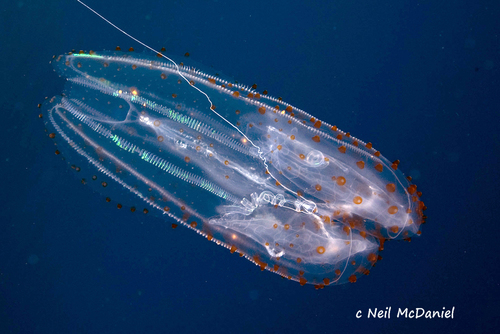
Ctenophora (; from Ancient Greek κτείς (kteis) 'comb' and φέρω (pherō) 'to carry') or ctenophores, commonly known as comb jellies, is a basal phylum of marine invertebrate animals notable for their unique aquatic locomotion using groups of cilia (commonly referred to as "combs"). They inhabit marine habitats worldwide, with 186 recognised living species.

Ctenophores are the largest animals to swim with cilia, with adult ctenophores range from a few millimeters to 1.5 m (5 ft) in size depending on the species. Their bodies consist of a mass of jelly (mesoglea) with a two-cell-thick layer on the outside, and another lining the internal cavity. The phylum has a wide range of body forms, including the egg-shaped cydippids with a pair of retractable tentacles that capture prey; the flat, generally combless platyctenids; and the large-mouthed beroids, which prey on other ctenophores.

Almost all ctenophores are predators, feeding on prey ranging from microscopic larvae and rotifers to the adults of small crustaceans; the exceptions are juveniles of two species, which live as parasites on the salps on which adults of their species feed.

Appearance

For a phylum with relatively few species, ctenophores have a wide range of body plans. Coastal species need to be tough enough to withstand waves and swirling sediment particles, while some oceanic species are so fragile that it is very difficult to capture them intact for study. In addition, oceanic species do not preserve well, and are known mainly from photographs and from observers' notes. Hence most attention has until recently concentrated on three coastal genera – Pleurobrachia, Beroe and Mnemiopsis. At least two textbooks base their descriptions of ctenophores on the cydippid Pleurobrachia.

Diet

When prey is swallowed, it is liquefied in the pharynx by enzymes and muscular contractions of the pharynx. The resulting slurry is wafted through the canal system by the beating of the cilia, and digested by the nutritive cells. The ciliary rosettes may help to transport nutrients to muscles in the mesoglea. The anal pores may eject unwanted small particles, but most unwanted matter is regurgitated via the mouth.

Little is known about how ctenophores get rid of waste products produced by the cells. The ciliary rosettes in the gastrodermis may help to remove wastes from the mesoglea, and may also help to adjust the animal's buoyancy by pumping water into or out of the mesoglea.

Behaviour

Ctenophores are found in most marine environments: from polar waters at −2 °C to the tropics at 30 °C; near coasts and in mid-ocean; from the surface waters to the ocean depths at more than 7000 meters. The best-understood are the genera Pleurobrachia, Beroe and Mnemiopsis, as these planktonic coastal forms are among the most likely to be collected near shore.

Reproduction

Adults of most species can regenerate tissues that are damaged or removed, although only platyctenids reproduce by cloning, splitting off from the edges of their flat bodies fragments that develop into new individuals. Lab research on Mnemiopsis leidyi also show that when two individuals have parts of their bodies removed, they are able to fuse together, including their nervous and digestive systems, even when the two individuals are genetically different; a phenomenon so far only found in comb jellies.

Where to see it

No dive sites list Comb Jelly yet. Explore the map to find sites near you.