
← All marine life
Cobia
Species IUCN · Least Concern (LC)

Cobia

Rachycentron canadum, (Linnaeus, 1766)

marinebrackish

About Cobia

The cobia (Rachycentron canadum) (, KOH-bee-ə) is a species of marine carangiform ray-finned fish, the only extant representative of the genus Rachycentron and the family Rachycentridae. Its other common names include black kingfish, black salmon, ling, lemonfish, crabeater, prodigal son, codfish, and black bonito.

Appearance

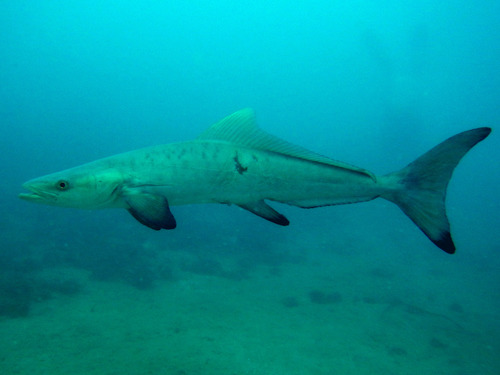
Attaining a maximum length of 2 m (78 in) and maximum weight of 79 kg (174 lb), the cobia has an elongated, fusiform (spindle-shaped) body and a broad, flattened head. The eyes are small and the lower jaw projects slightly past the upper. Fibrous, villiform teeth line the jaws, the tongue, and the roof of the mouth. The body of the fish is smooth with small scales. It is dark brown in color, grading to white on the belly, with two darker brown horizontal bands on the flanks. The stripes are more prominent during spawning, when they darken and the background color flashes.

Habitat

It is found in warm-temperate to tropical waters of the West and East Atlantic Ocean, throughout the Caribbean, and in the Indian Ocean off the coast of India, Australia, and the Pacific coast of Japan.

Behaviour

The cobia feeds primarily on crabs, squid, and fish. Like its relatives the remoras, it follows larger animals such as sharks, turtles, and manta rays to scavenge. It is a very curious fish, showing little fear of boats.

The predators of the cobia are not well documented, but the mahi-mahi (Coryphaena hippurus) is known to feed on juveniles and the shortfin mako shark (Isurus oxyrinchus) eats the adults.

The cobia is frequently parasitized by nematodes, trematodes, cestodes, copepods, and acanthocephalans. Cobia are susceptible to multiple parasitic and bacterial infections such as Amyloodinium species, Photobacterium damselae subsp. piscicida and Lactococcus garvieae.

Reproduction

The cobia is a pelagic spawner, releasing many tiny (1.2 mm), buoyant eggs into the water, where they become part of the plankton. The eggs float freely with the currents until hatching. The larvae are also planktonic, being more or less helpless during their first week until the eyes and mouths develop. The male matures at two years and the female at three years. Both sexes lead moderately long lives of 15 years or more. Breeding activity takes place diurnally from April to September in large, offshore congregations, where the female is capable of spawning up to 30 times during the season.

While there are rare occurrences of intersex individuals (most likely due to endocrine-disrupting compounds in the water) they mostly have a fixed sex with a putative XX/XY mode of sex determination responsible for this.

Where to see it

No dive sites list Cobia yet. Explore the map to find sites near you.