
← All marine life
Christmas Tree Worm
Species

Christmas Tree Worm

Spirobranchus giganteus, (Pallas, 1766)

marine

About Christmas Tree Worm

Spirobranchus giganteus, commonly known as the Christmas tree worm, is a polychaete worm belonging to the family Serpulidae building calcareous tubes. The S. giganteus lives in coral reefs in the Caribbean.

Appearance

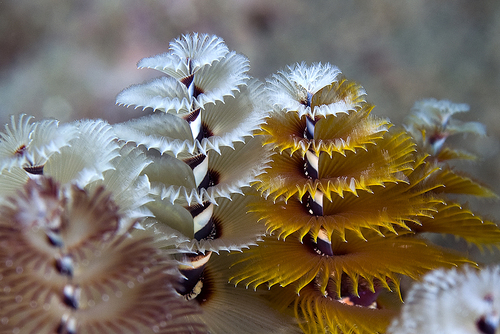
Both its common and Latin names refer to the two chromatically hued spiral structures, the most common feature seen by divers. The multicolored spirals are highly derived structures for feeding and respiration.

Spirobranchus giganteus is similar to most tube-building polychaetes. It has a tubular, segmented body of an approximate length of 3.8 cm (1.5 in) covered with chaetae, small appendages that aid the worm's mobility. Because it does not move outside its tube, this worm does not have any specialized appendages for movement or swimming.

Behaviour

S. giganteus is commonly found embedded entirely in heads of massive corals, such as stony corals Porites and brain corals. Like members of its family, it can secrete a calcareous tube around its body. This tube serves as the worm's home and protection. Calcareous tube can reach up to 20 cm in length. They are usually deeply embedded in the coral skeleton. S. giganteus usually settles onto an existing head of living coral before secreting its tube, thereby increasing its level of protection as coral tissue overgrows the calcareous tube. When the worm retreats into its tube, the opening is shut using an operculum, which is further protected by sharp, antler-shaped spines.

Reproduction

There are both male and female Christmas tree worms, Spirobranchus giganteus. They reproduce by casting their eggs and sperm into the water. The eggs are fertilized in the water then develop into larvae that settle on coral heads and then burrow into the coral to form their burrows.

Humans & conservation

While the worm itself has no commercial fishery importance, it is of interest to marine aquarists and divers. The variously colored worm crowns make extremely popular underwater photographic subjects for sport divers. Many aquarists who have miniature reef aquaria purposely include heads of coral that S. giganteus specimens inhabit.

Part of

Where to see it

No dive sites list Christmas Tree Worm yet. Explore the map to find sites near you.