
← All marine life
Chilipepper
Species

Chilipepper

Sebastes goodei, (Eigenmann & Eigenmann, 1890)

marine

About Chilipepper

Sebastes goodei, the chilipepper rockfish and chilipepper, is a species of marine ray-finned fish belonging to the subfamily Sebastinae, the rockfishes, part of the family Scorpaenidae. This species lives mainly off the coast of western North America from Baja California to Vancouver.

Appearance

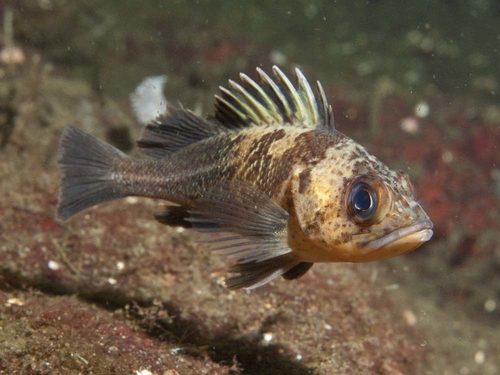
The body of Sebastes goodei is slender and rather elongate. The head is elongate, pointed and with no spines; the lower jaw is projecting. The adult fish is generally pinkish-red becoming whitish below with pink fins. Juveniles are light olive on back. The middle of the chillipepper's side, the lateral line, stands out clearly, as a lighter, bright red zone. In comparison to the bocaccio, it has a smaller mouth with an upper jaw that extends only to about the center of the eye, not past it. Chilipeppers may live to be 35 years old. The record length is 22 inches (56 cm), and weight is 5.25 pounds.
Habitat

Sebastes goodei is found in the eastern Pacific Ocean along the western coast of North America from Queen Charlotte Sound in British Columbia south to Magdalena Bay, Baja California Sur. The adults are demersal fish and can be found on rocky reefs, and also on sand and mud substrates in deepwater while the young are pelagic and live shallower water. The depth range of this species is 0 to 425 m (0 to 1,394 ft).

Humans & conservation

Sebastes goodei is an important commercial target species in Californian waters and are taken mainly by hook and line, gill nets, and trawls. It is fished for by recreational fishermen but this activity seems to be decreasing. The chilipepper rockfish is considered to be an excellent food fish. In 1995 a total of more than 2,000 t (2,000 long tons; 2,200 short tons) was landed by commercial fisheries in California and Oregon but in 2006 this had fallen to 43.2 t (42.5 long tons; 47.6 short tons), although the population was estimated to have increased. The fall in landings is thought to be a result of reduced fishing effort due to conservation measures designed to protect the stocks of other rockfish species.

Part of

Where to see it

No dive sites list Chilipepper yet. Explore the map to find sites near you.