
← All marine life
Chilean Abalone
Species

Chilean Abalone

Concholepas concholepas, (Bruguière, 1789)

marine

About Chilean Abalone

Concholepas concholepas, the Chilean abalone or Peruvian tolina, is a species of large edible sea snail, a marine gastropod mollusk. Despite the superficial resemblance, C. concholepas is not a true abalone (a species in the family Haliotidae), but a member of the family Muricidae, also known as murex snails or rock snails. This species is native to the coasts of Chile and Peru, where it is called loco (a Chilean Spanish loanword from Mapudungun), pata de burro, tolina, or chanque (Peruvian Spanish).

Due to overfishing, the harvesting of this species in Chile has been limited by law since 1989.

Appearance

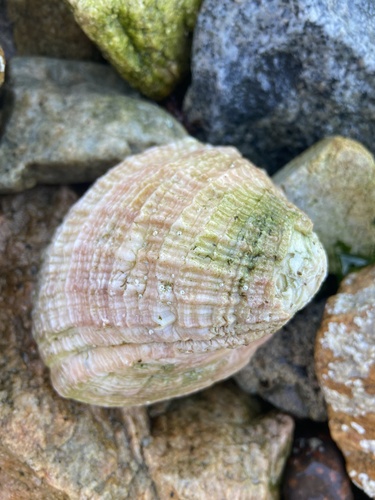
Concholepas concholepas has a thick, slightly oval, and white-brown to purple-grey shell. Its very few whorls makes it resemble a Phrygian cap in shape. The outer surface of the shell shows strong lamellose ribs of which are both radial and circular-concentric.

The shell is shaped almost like that of an abalone, with a very large aperture compared to other muricids. A loco cannot hide completely inside the shell if it is turned upside down, so has no need of its operculum; instead, it relies on its strong foot to remain in place. The shell is made of calcite with an inner layer of aragonite.

The shells of this species are used as ashtrays in Chile.

Behaviour

Concholepas concholepas is a benthic predator that lives on rocks in temperate waters from sea level to depths of 40 m. Its diet consists of mytilids (such as Semimytilus algosus and Perumytilus purpuratus) and barnacles (such as Chthamalus scabrosus).

Its geographic distribution ranges from Lobos de Afuera in Peru, to Cape Horn in Chile, including the Juan Fernández Islands.

Humans & conservation

Concholepas concholepas is used in Chilean cuisine and is commercially marketed worldwide as a delicacy — misleadingly under the name "Chilean abalone". (True abalone are herbivores, whereas Concholepas concholepas is a muricid, a carnivore). Its economic value and ecological importance as top predator have made it the most studied marine invertebrate species in Chile.

Where to see it

No dive sites list Chilean Abalone yet. Explore the map to find sites near you.