
← All marine life
Cape Fur Seal
Species IUCN · Least Concern (LC)

Cape Fur Seal

Arctocephalus pusillus, (Schreber, 1775)

marine

About Cape Fur Seal

Arctocephalus pusillus, commonly known as the Afro-Australian fur seal, or brown fur seal is a species of fur seal. The species is often referred to as the Cape fur seal, although this name is also used specifically for the nominate subspecies, A. p. pusillus, of southern Africa. The other subspecies, A. p. doriferus, is found in Australia and is known as the Australian fur seal.

Appearance

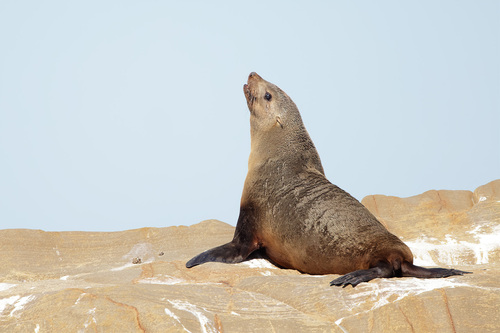
Arctocephalus pusillus is the largest and most robust member of the fur seals. It has a broad, flat head with a pointed snout that may be slightly upturned. It has external ear flaps (pinnae) and its whiskers (vibrissae) are long, possibly extending past the pinnae, especially in adult males. The fore-flippers are covered with sparse hairs over about three-quarters of their length. The hind flippers are short relative to the large body, with short, fleshy tips on the digits. The size and weight of the brown fur seal depend on the subspecies; the Southern African subspecies is, on average, slightly larger than the Australian subspecies. Males of the African subspecies (A. p. pusillus) are 2.3 m (7.5 ft) in length on average and weigh 200–300 kg (440–660 lb). Females are smaller, averaging 1.8 m (5.9 ft) in length and typically weighing 120 kg (260 lb).

Behaviour

The African fur seal inhabits the southern and southwestern coast of Africa, from Cape Cross, Namibia to around the Cape of Good Hope and from Black Rocks, near Port Elizabeth in the Eastern Cape province. The Australian fur seal lives in the Bass Strait, on four islands off Victoria (southeastern Australia), and five islands off Tasmania. Brown fur seals prefer to haul-out and breed on rocky outcrops and small islands, rock ledges and exposed reefs, as well as on rocky, pebble or boulder beaches. However, some larger colonies can be found on sandy beaches, such as in South Africa. Fur seals spend most of the year at sea, but are never too far from land. They have been recorded 160 km from land, but this is not common.

Reproduction

Brown fur seals often gather into colonies on rookeries in numbers ranging from 500 to 1500, at least for the Australian subspecies. While fur seals spend most of the year at sea, they never fully evacuate the rookeries, as mothers and pups return to them throughout the year. No dispersal from a colony is established, although some fur seals from one colony have been found at another. True boundaries do not exist between the colonies. When at sea, they travel in small feeding groups. Brown fur seals begin to breed in the middle of October, when males haul out on shore to establish territories through display, vocalizations, sparring, and sometimes actual combat. They fast at this time and do not eat until after mating in November or December. When the females arrive, they fight among themselves for territories in which to give birth.

Humans & conservation

This species is an inquisitive and friendly animal when in the water, and often accompanies scuba divers. They swim around divers for periods of several minutes at a time, even at a depth of 60 m. On land, they are far less relaxed and tend to panic when humans come near them.

Australian fur seals were hunted intensively between 1798 and 1825 for commercial reasons. Seal hunting stopped in Australia in 1923, and their population is still recovering, causing increasing friction with South Australian fishermen as their range expands. Breeding and haul-out sites are protected by law. South African fur seals have a robust, healthy population. Seal hunting was outlawed in South Africa in 1990.

Where to see it

No dive sites list Cape Fur Seal yet. Explore the map to find sites near you.