
← All marine life
Canary Wrasse
Species IUCN · Least Concern (LC)

Canary Wrasse

Halichoeres chrysus, Randall, 1981

marine

About Canary Wrasse

Halichoeres chrysus, commonly called the canary wrasse, golden wrasse or yellow wrasse, is a wrasse native to the central Indo-Pacific area.

Appearance

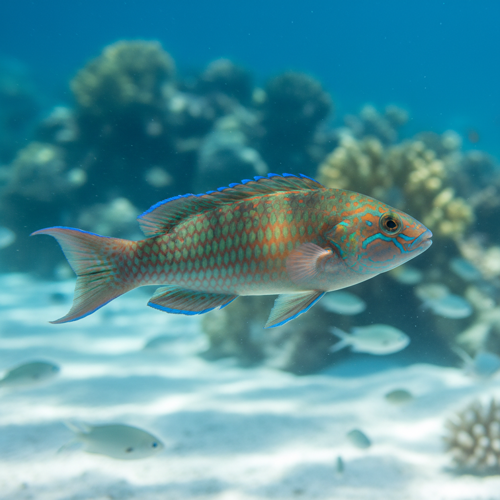
Halichoeres chrysus is a small fish that can reach a maximum length of 12 cm. It has a thin, elongate body with a terminal mouth. Body coloration is bright yellow with a few variations according to age. Juveniles and immature females have two black spots rimmed with white or light yellow on the dorsal fin and a third one between the caudal peduncle and the caudal fin; in contrast, matures females or young males only show the two black spots on the dorsal fin. Mature males display only the first black spot in the front of the dorsal fin, a lighter-colored spot just behind the eye and irregular greenish to pinkish bars on the face.
Habitat

Halichoeres chrysus is quite widespread throughout the tropical and subtropical waters of the central Indo-Pacific, in an area bordered by the Christmas Islands and Indonesia, Japan, New South Wales and the Rowley Shoals, and Tonga and the Solomon Islands. This wrasse occurs on outside reef slopes, in rubble and sandy areas from surface down to a depth of 30 m.

Humans & conservation

On the IUCN Red List, Halichoeres chrysus is listed as a Least Concern Species. It is targeted but not thought to be threatened by the aquarium trade.

Part of

Where to see it

No dive sites list Canary Wrasse yet. Explore the map to find sites near you.