
← All marine life
Bullseye Puffer
Species IUCN · Least Concern (LC)

Bullseye Puffer

Sphoeroides annulatus, (Jenyns, 1842)

marinebrackish

About Bullseye Puffer

Sphoeroides annulatus, commonly known as the bullseye puffer, is a species of fish in the family Tetraodontidae, or pufferfishes. It is found in the eastern Pacific Ocean from California, USA to Pisco, Peru and the Galápagos Islands.

Appearance

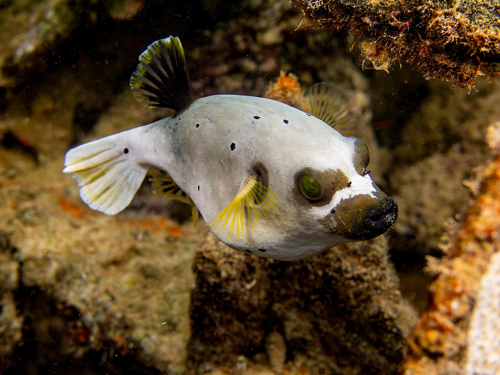
Sphoeroides annulatus has a moderately elongated body with a depth that is 25% to 33% of the standard length. Their back is olive-brown, and their flat ventral side is white. Their head and back have narrow yellowish lines, bars, and oblique bands, and 3 narrow bands behind the eyes. There is a double concentric oval on their back that resembles a 'bullseye', even though this may be obscure in large adults (Jenyns 1842). Their head, sides, and upper back are covered with small dark spots. They have a yellow iris and spotless fins. Their head is large, projecting, and blunt and the gap between their elevated eyes is wide and convex. They have powerful, strong teeth. Their dorsal and anal fins are small with 6 to 9 rays with short bases, located farther back on their body with the anal fin being slightly behind the dorsal fin.
Habitat

Globally, there are twenty-three species in the genus  Sphoeroides. Of these eleven are found in Mexican waters, six in the Atlantic, and five in the Pacific Ocean. Three species of puffer span along the north-west of the Mexican Pacific coastline. Sphoeroides annulatus, commonly known as the bullseye puffer, is distributed along the eastern Pacific Ocean, from south California, USA, to the Peruvian coasts, including the Gulf of California and Galápagos Islands.

Diet

Sphoeroides annulatus  can ingest feed particles on the water surface, particles sinking in the water column, and resting on the bottom. Studies are in progress to evaluate the suitability of feeding either floating or sinking feed particles, or a combination of the two. This is based on species in aquaculture. This species feeds on insects, crustaceans, and small fish in the wild. They can use their beak like mouth to remove shellfish from their shells.

Behaviour

When young, Sphoeroides annulatus are often found in pure freshwater but migrate to brackish or full marine waters as they reach adulthood. Successful hatchery production of larvae and juveniles has been achieved. This is important for their mass production to supply fish farms with juveniles for growing at the commercial scale. Parental investment is known in the Sphoeroides maculatus where the males defend the eggs until they hatch. Other Sphoeroides spawn between May and August in shallow sandy or muddy water.

Humans & conservation

From a conservation perspective, Sphoeroides annulatus is currently considered to be of least concern. It has a stable, widely distributed population. They are a targeted species by subsistence fishermen off the beaches of Baja California Sur via hook and line and in certain locations can be caught in abundance. They are often encountered mid-water by divers. Their largest threat is habitat loss.

Part of

Where to see it

No dive sites list Bullseye Puffer yet. Explore the map to find sites near you.