
← All marine life
Bull Ray
Species IUCN · Critically Endangered (CR)

Bull Ray

Aetomylaeus bovinus, (Geoffroy Saint-Hilaire, 1817)

marinebrackish

About Bull Ray

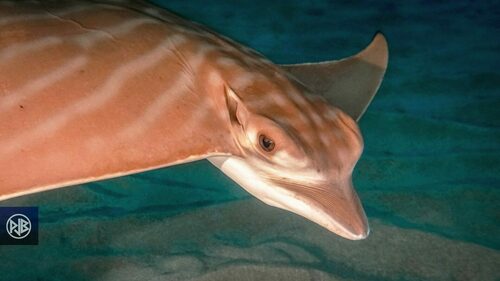
Aetomylaeus bovinus, also known as the bull ray, duckbill ray, or duckbill eagle ray, is a species of large stingray of the family Myliobatidae found around the coasts of Europe and Africa.

Habitat

The full distribution of the bull ray is uncertain but it is known to be found in the Mediterranean Sea, the Black Sea, the eastern Atlantic Ocean between Portugal and Guinea, the Atlantic from north of Saldanha Bay in western South Africa and round the rest of the South African coast into the Indian Ocean up to Maputo Bay in southern Mozambique, also Zanzibar and Kenya.

It is found between the surf zone and depths of 65 m (213 ft) or more and also enters estuaries and lagoons. Some of these shallow coastal habitats may function as nursery areas, such as in Malta.

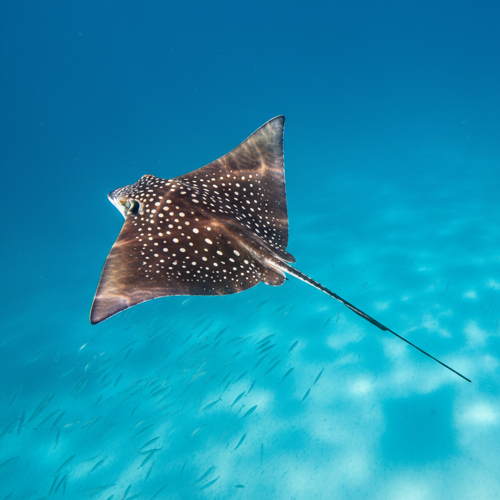
The species frequents both the bottom and the surface and sometimes leaps from the water.
Behaviour

The species is ovoviviparous and reach sexual maturity at four to six years old. With a low fecundity of three to four pups per litter and a long gestation of six to 12 months (depending on the geographical zone), this species has a very sensitive life history.

Very little is known concerning the ecology and behavior of A. bovinus. However, it is part of the coastal marine megafauna, and with a maximum discal width (tip to tip) of 2.22 m (7 ft 3 in), 1.5 m (4 ft 11 in) in length and weighing up to 116 kg (256 lb), bull rays can be considered as giants of the shallow waters. Like in many elasmobranch species, females are larger and heavier than males. The species does exhibit some schooling behaviours, that are currently not understood.

Humans & conservation

Aetomylaeus bovinus is facing various and numerous threats, from fisheries to habitat degradation. As it is a benthic and semi-pelagic feeder, it is by-catch by a large game of industrial or artisanal fishing gear, especially pelagic trawling, bottom trawling, trammel nets, gill nets and spearfishing.

Little information is available concerning this species in Africa. However, old literature refers to a discard of 900 t (890 long tons; 990 short tons) per year of bull rays by-caught by shrimp trawlers on the West African coast in 1988 during their late juvenile and sub/adult phase.

Part of

Where to see it

No dive sites list Bull Ray yet. Explore the map to find sites near you.