← All marine life
Bryozoan
Group

Bryozoan

Bryozoa

marinebrackishfreshwater

About Bryozoan

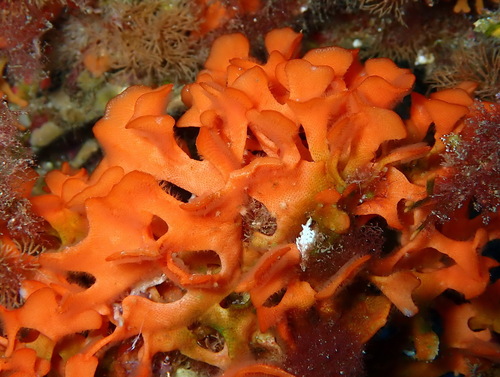
The Bryozoa (also known as the Polyzoa, Ectoprocta or commonly as moss animals) are a phylum of simple, aquatic invertebrate animals, nearly all living in sedentary colonies. Typically about 0.5 millimetres (1⁄64 in) long, they have a special feeding structure called a lophophore, a "crown" of tentacles used for filter feeding. The bryozoa are classified as the marine bryozoa (Stenolaemata), freshwater bryozoa (Phylactolaemata), and mostly-marine bryozoa (Gymnolaemata), a few members of which prefer brackish water. Most marine bryozoans live in tropical waters, but a few are found in oceanic trenches and polar waters. 5,869 living species of bryozoa are known. Originally all of the crown group Bryozoa were colonial, but as an adaptation to a mesopsammal (interstitial spaces in marine sand) life or to deep-sea habitats, secondarily solitary forms have since evolved. Five genera are solitary: Aethozooides, Aethozoon, Franzenella, Solella, which together make up the family Aethozoidae, and Monobryozoon, which has a statocyst-like organ with a supposed excretory function.

The terms Polyzoa and Bryozoa were introduced in 1830 and 1831, respectively. Soon after it was named, another group of animals was discovered whose filtering mechanism looked similar, so it was included in Bryozoa until 1869, when the two groups were noted to be very different internally. The new group was given the name "Entoprocta", while the original Bryozoa were called "Ectoprocta". Disagreements about terminology persisted well into the 20th century, but "Bryozoa" is now the generally accepted term.

Appearance

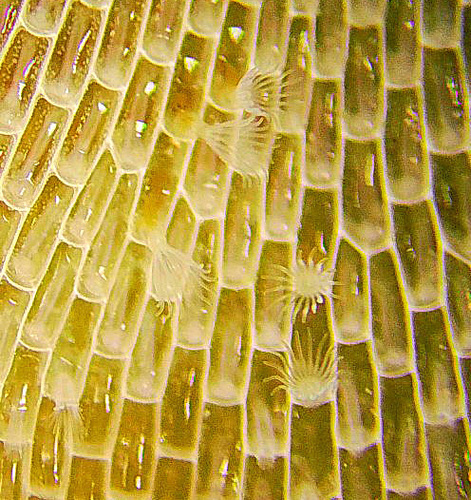
Bryozoans, phoronids and brachiopods strain food out of the water by means of a lophophore, a "crown" of hollow tentacles. Bryozoans form colonies consisting of clones called zooids that are typically about 0.5 mm (1⁄64 in) long. Phoronids resemble bryozoan zooids but are 2 to 20 cm (1 to 8 in) long and, although they often grow in clumps, do not form colonies consisting of clones. Brachiopods, generally thought to be closely related to bryozoans and phoronids, are distinguished by having shells rather like those of bivalves. All three of these phyla have a coelom, an internal cavity lined by mesothelium.

Diet

The most common type of zooid is the feeding autozooid, in which the polypide bears a "crown" of hollow tentacles called a lophophore, which captures food particles from the water. In all colonies a large percentage of zooids are autozooids, and some consist entirely of autozooids, some of which also engage in reproduction.

Behaviour

Most marine species live in tropical waters at depths less than 100 meters (330 ft; 55 fathoms). However, a few have been found in deep-sea trenches, especially around cold seeps, and others near the poles.

Reproduction

Gonozooids act as brood chambers for fertilized eggs. Almost all modern cyclostome bryozoans have them, but they can be hard to locate on a colony because there are so few gonozooids in one colony. The aperture in gonozooids, which is called an ooeciopore, acts as a point for larvae to exit. Some gonozooids have very complex shapes with autozooidal tubes passing through chambers within them. All larvae released from a gonozooid are clones created by division of a single egg; this is called monozygotic polyembryony, and is a reproductive strategy also used by armadillos.

Cheilostome bryozoans also brood their embryos; one of the common methods is through ovicells, capsules attached to autozooids. The autozooids possessing ovicells are normally still able to feed, however, so these are not considered heterozooids.

Humans & conservation

Marine species are common on coral reefs, but seldom a significant proportion of the total biomass. In temperate waters, the skeletons of dead colonies form a significant component of shell gravels, and live ones are abundant in these areas. The marine lace-like bryozoan Membranipora membranacea produces spines in response to predation by several species of sea slugs (nudibranchs). Other predators on marine bryozoans include fish, sea urchins, pycnogonids, crustaceans, mites and starfish. In general marine echinoderms and molluscs eat masses of zooids by gouging pieces of colonies, breaking their mineralized "houses", while most arthropod predators on bryozoans eat individual zooids.

In freshwater, bryozoans are among the most important filter feeders, along with sponges and mussels. Freshwater bryozoans are attacked by many predators, including snails, insects, and fish.

Species in this group

Where to see it

No dive sites list Bryozoan yet. Explore the map to find sites near you.