← All marine life
Brook Stickleback
Species IUCN · Least Concern (LC)

Brook Stickleback

Culaea inconstans, (Kirtland, 1840)

freshwater

About Brook Stickleback

The brook stickleback (Culaea inconstans) is a small freshwater fish that is distributed across the US and Canada. It grows to a length of about 2 inches. It occupies the northern part of the eastern United States, as well as the southern half of Canada. Small populations are scattered throughout the Mississippi-Great Lakes basin extending to Colorado, New Mexico, Kentucky, Tennessee, etc., though some of these areas are not native to the species. This small fish inhabits clear, cool streams and lakes. They eat small Invertebrates, algae, insect larvae, and occasionally their own eggs. They are also preyed upon by smallmouth bass and northern pike. Feeding time is usually dawn and sunset. The brook stickleback does have active competition mostly from minnows, but feeding times are different, along with diet. Spawning occurs in midsummer. Males secure a territory, build a nest, and mate with females. Males provide protection for the eggs, ward off predators, and usually die later in the season. The nests are built out of aquatic grasses. This is considered an annual species. Though the brook stickleback is not considered a threatened species, deforesting and changing waters are altering ecosystems of the species. Harvesting of trees around riparian environments is having a large effect of the stream ecosystem where the brook stickleback resides.

Appearance

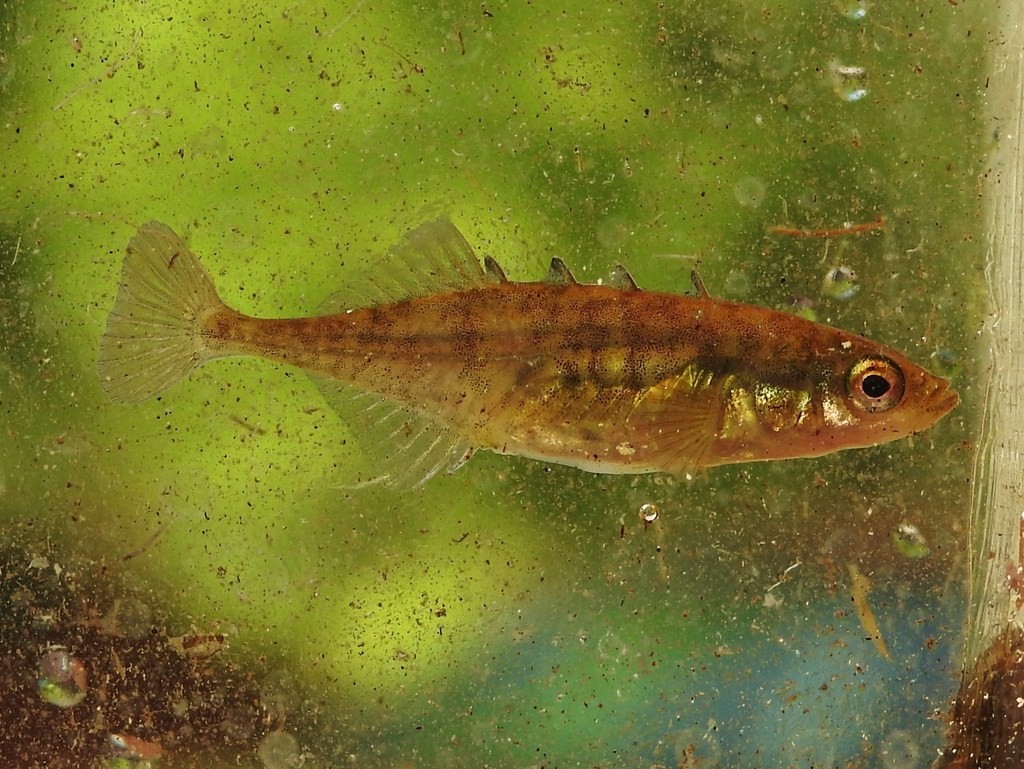
The brook stickleback has a tapered body with a slim caudal peduncle and a fan-shaped tail. It very much resembles the ninespine stickleback (Pungitius pungitius) but only has five, or occasionally six, dorsal spines. It also lacks lateral bony plates. Most of the year the colouring is grayish or olive green with a varying amount of indistinct mottling, but during the spawning season, males are nearly black and females have darker and lighter patches. This species grows to a maximum length of 3 to 5 cm (1.2 to 2.0 in).

Habitat

Culaea inconstans occurs throughout the southern half of Canada and the northern part of the eastern United States. It is one of the smallest fishes in the region. Brackish water populations are uncommon but certainly exist. It extends down to the southern reaches of the Mississippi River – Great Lakes drainage basins. Populations also exist in Colorado and Nebraska to the west, and in Alberta, Saskatchewan, Manitoba, and the Northwest Territories to the north. Though these are typically the native ranges of the brook stickleback, the species has been introduced to Alabama, Kentucky, Tennessee, northwestern Colorado, Wyoming, northeastern Utah and California, and even in parts of South Dakota and Washington State. Certain geographical distribution studies have found that certain populations may have been native in New Mexico and still exist today.

Diet

The brook stickleback is an omnivore, with primary feeding tendencies toward aquatic insect larvae, adult terrestrial insects, crustaceans, fish eggs and larvae, snails, oligochaetes, nematodes, rotifers, and mites. However, brook stickleback feed on vascular plant material, as well as algae. Newly hatched stickleback larvae and planktonic crustaceans from both streams and ponds. Juveniles eat small organisms due to mouth size restrictions, and adults eat both large and small organisms.

Behaviour

As with a large geographical distribution, this species also lives in a wide range of flowing water habitats. Waterways such as rivers, streams, floodwater streams and drainages, lakes, ponds, potholes, hot springs, sinkholes, and seasonal melt water or spring fed ponds are all viable brook stickleback territories. Though the species can thrive in these habitats, primary spawning, breeding, and rearing grounds are located in shallow (< 1.5m) near shore environments with high vegetation cover and low velocity water. The species has a wide elevation range with specimens identified from sea level to ~ 2,400m.

Humans & conservation

Although the Nature Conservancy has listed the brook stickleback as level S3 (vulnerable), the numbers of this species aren't threatened. The species is observed to be migrating westward and is seen as an invasive species in Wyoming. The strength of this species' success in its natural environment is seen in the amount of locations it has successfully colonized after the last ice age with the northern retreat of the glacial caps.

Where to see it

No dive sites list Brook Stickleback yet. Explore the map to find sites near you.