
← All marine life
Brooding Anemone
Species

Brooding Anemone

Epiactis prolifera, Verrill, 1869

marine

About Brooding Anemone

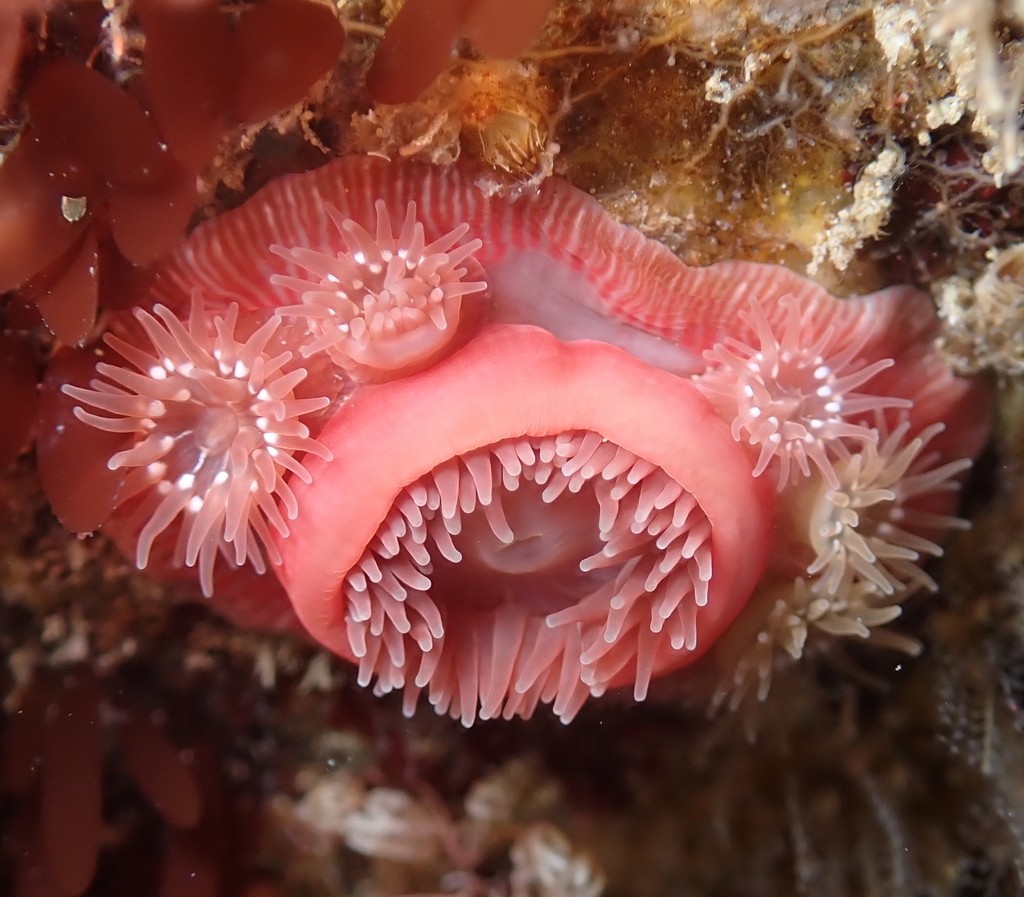
Epiactis prolifera, the brooding, proliferating or small green anemone, is a species of marine invertebrate in the family Actiniidae. It is found in the north-eastern Pacific. It has a feature rare among animals in that all individuals start life as females but develop testes later in their lives to become hermaphrodites.

Appearance

The brooding anemone grows to three centimetres high and up to five centimetres in diameter and varies in colour, usually being greenish-brown but sometimes brown, pink, red or dull green. There are fine white lines starting at the mouth and spreading radially across the oral disc and further white lines occur on the column and pedal disc. The lower part of the column and pedal disc are occasionally blue. There are often radiating pale and dark lines on the edges of the pedal disc and the lower part of the column. The mouth is surrounded by 48 to 96 short, conical tentacles each tipped with a terminal pore.

Habitat

The brooding anemone is found in shallow areas of the north-east Pacific Ocean. The highest density is on or under rocks in the sublittoral zone, in surge channels, on rock shelves and areas exposed to wave action. It is often found in areas encrusted with coralline algae and sometimes grows on the leaves of eelgrass. It cannot tolerate exposure to the drying air and sunlight. The brooding anemone moves around over the substrate to a greater extent than do other anemones.

Behaviour

Despite their stinging nematocysts, brooding anemones are a favoured prey for certain other animals. Many nudibranchs seem to be immune to the toxin and both eat them and can store the unused nematocysts for their own defence. Predators include the nudibranch Aeolidia papillosa, the leather star Dermasterias imbricata and certain fish, such as the mosshead sculpin (Clinocottus globiceps).

This anemone sometimes displays mutualism by attaching itself to a hermit crab or decorator crab. The anemone provides protection for the host from predators and itself benefits by being able to consume food fragments discarded by the crab.

The copepod, Doridicola sunnivae, is an ectoparasite of the brooding anemone.

Where to see it

No dive sites list Brooding Anemone yet. Explore the map to find sites near you.