
← All marine life
Bronze Seabream
Species IUCN · Least Concern (LC)

Bronze Seabream

Pachymetopon grande, Günther, 1859

marine

About Bronze Seabream

Pachymetopon grande, the bronze seabream or blue hottentot, is a species of marine ray-finned fishes belonging to the family Sparidae, which includes the seabreams and porgies. This species is found in the southwestern Indian Ocean. It is an important spoecies for recreational fisheries in South Africa and for subsistence fisheries too.

Appearance

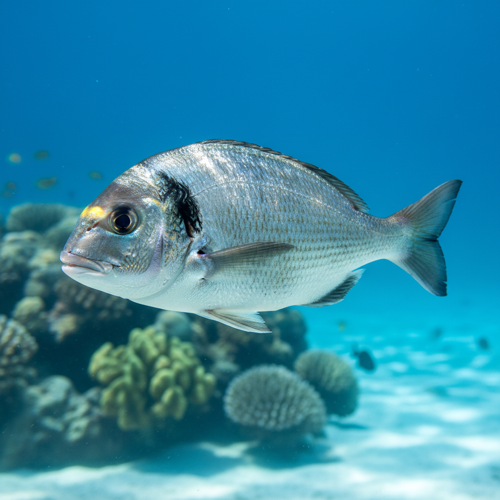
Pachymetopon grande has a rather rotund, deep body which has a standard length that is 2 to 2.3 times its depth. The dorsal profile of the head is smoothly convex with a slight protuberance in front of the eyes. The dorsal fin is supported by 11 spines and between 11 and 13 soft rays while the anal fin contains 3 spines and 10 or 11 soft rays. The overall colour of the body is bronze, paler on the belly and breast, with an iridescent blue head and blue pectoral fins. This species has a maximum total length of 65 cm (26 in), although 35 cm (14 in) is more typical.
Habitat

Pachymetopon grande is endemic to Southern Africa where it is distributed from Southern Mozambique to False Bay in the Western Cape., it has also been recorded off southern Madagascar. It is found in shallow waters of less than about 25 m (82 ft) in rocky areas.

Humans & conservation

Pachymetopon grande is heavily targeted by recreational fishers from the shore and by spear fishers but is not commercially targeted, although it is caught by subsistence fishers in the Eastern Cape. As a slow growing, late maturing, long lived, sedentary species this fish is vulnerable to overexploitation and there appears to have been a marked decline in numbers. There is a minimum size of 30 cm (12 in) and a bag limit of 2 fish per day for anglers. This species responds well to protection and numbers increase in Marine protected areas. The IUCN classify this fish as a Near-threatened species.

Part of

Where to see it

No dive sites list Bronze Seabream yet. Explore the map to find sites near you.