
← All marine life
Bowers' Parrotfish
Species IUCN · Near Threatened (NT)

Bowers' Parrotfish

Chlorurus bowersi, (Snyder, 1909)

marine

About Bowers' Parrotfish

Chlorurus bowersi, commonly known as the Bower's parrotfish or the orange-blotch parrotfish, is a species of ray-finned fish, a parrotfish from the family Scaridae. It is found in the Western Pacific Ocean from the Ryukyu Islands of Japan in the north to Java, Papua and the Philippines in the south, and east to Micronesia.

This species is found in reef flats and fronts in sheltered areas or where there is moderate exposure to the currents or waves. This is a relatively small parrotfish generally found in pairs which excavates burrows. It feeds on filamentous algae. Chlorurus bowersi was first formally described as Callyodon bowersi in 1909 by the American ichthyologist John Otterbein Snyder (1867-1943) and the type locality was given as Naha, Okinawa, Japan.

Appearance

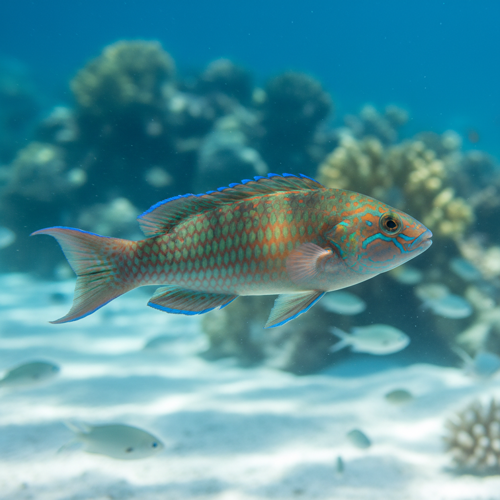
Chlorurus bowseri has a small, elongated, compressed body and a rounded snout. The dorsal fin of the fish is continuous, accompanied by 9 spines and 10 soft rays. The anal fin of the fish contains 3 spines followed by 9 rays. The pectoral fin of C. bowersi contains between 13 and 17 rays, and the pelvic fin contains 1 spine and 5 rays. The main scales of the fish are cycloid scales and are relatively large, while the fish also has cheek scale rows (1 to 4) as well as median predorsal scales (2 to 8). The lateral line of the fish consists of 22-24 pored scales and is interrupted. Chlorurus bowersi is a brightly colored blue-green fish with patches of orange on the head, pectoral fins, pelvic fins, and orange streaks throughout the dorsal and anal fins.
Habitat

In Okinawa, no clear trend in the distribution of C. bowersi was observed, but it was seen in the inner and exposed reefs. In Natuna Island, C. bowersi was found around the shallower areas of reefs alongside other parrotfish species.

Reproduction

Chlorurus bowersi is considered to have an important role in maintaining balance within the coral reef ecosystem. The fish scrapes off algae from the surfaces of dead coral with the assistance of their beak-like dentition, preventing the growth of algae, which allows for the use of the corals by other organisms. This also plays a role in the bioerosion of coral reefs, which is important in the processing of building reef environments.

Humans & conservation

Chlorurus bowersi holds significance among humans primarily through fisheries, food, economic value, and tourism. Many residents along the coast of Indonesia and within the Coral Triangle rely on the coral reef fisheries and have utilized a variety of fishing methods to do so. This includes various target species, gear, and use of available habitats. While the fisheries are used to support human populations, exploitation of these resources can negatively impact the ecosystem populations as well as the tourism and diving industries.

Part of

Where to see it

No dive sites list Bowers' Parrotfish yet. Explore the map to find sites near you.